


A shop vac hose should match the vacuum cuff, tool port, debris type, and required reach. Common nominal sizes are 1-1/4, 1-7/8, and 2-1/2 inches, but those labels don’t guarantee that the cuffs will fit.
Table of Contents
Best Shop Vac Hoses by Use
The best hose depends on whether you need bulky-debris capacity, flexible tool extraction, or a compact replacement. Start with fit data, then compare length, construction, adapters, and the cost of any extra couplings.
Comparison Table and Fit Data
This table separates the hose-body size from the connection details. Marketplace descriptions often omit actual cuff measurements, so verify the vacuum model and both mating diameters before ordering.
| Product | Length | Nominal diameter | Connection and adapters | Best application | Claims to verify | Typical price band |
|---|---|---|---|---|---|---|
| Shop-Vac Heavy-Duty Hose | 8 ft | 2-1/2 in | Standard or locking inlet compatibility; check cuff dimensions | Large chips and floor cleanup | Wet pickup, swivel, warranty, exact models | $25–$60 |
| CRAFTSMAN POS-I-LOCK Hose | 20 ft | 2-1/2 in | POS-I-LOCK vacuum connection | Long workshop reach | Supported vacuum models, wet use, warranty | $35–$80 |
| POWERTEC Dust Hose Kit | 10 ft | Check listing | Five fittings included | Mixed woodworking tools | Actual adapter diameters and swivel action | $25–$60 |
| POWERTEC Shop Vac Hose Kit | 10 ft | Check listing | Power-tool connection kit | Saws and benchtop machines | Vacuum-side cuff and tool-port range | $25–$60 |
| Universal Power Tool Hose Kit | 10 ft | Check listing | Multi-tool adapters | Portable-tool extraction | Brand fit, restriction, antistatic claim | $25–$60 |
| Heavy-Duty Compact Hose | 4 ft | 1-1/4 in | Listed for Shop-Vac 9196300 | Compact vacuums | Model fit, crush resistance, warranty | $15–$35 |
| Hon and Guan Vac Hose Kit | 16 ft | 1-1/4 in hose | Quick-connect adapters covering larger ports | Multi-brand mobile use | Adapter seal and claimed diameter range | $35–$80 |
| IWIWE Replacement Hose | 10 ft | 1-1/4 in hose | 2-1/4 in cuff; selected brand compatibility | Replacement and detail cleanup | Exact Shop-Vac, CRAFTSMAN, and RIDGID models | $25–$60 |
The listed price bands are useful for budgeting, but a cheap hose can become the costlier setup after buying two reducers and a proprietary cuff. Product descriptions supplied here don’t confirm every inside diameter, wet-use approval, conductivity claim, or warranty term.
Heavy-Debris and Large-Inlet Hoses
A 2-1/2-inch hose suits large chips, vehicle cleaning, floor nozzles, and full-size wet/dry vacuums. An 8-foot hose preserves more performance and stores easily; a 20-foot hose reaches farther but drags across corners, forms heavy coils, and adds friction.
These two large-inlet hoses suit demanding cleanup where reach and debris capacity matter.

Shop-Vac Heavy-Duty 8 Foot Hose
- Eight foot reach for wider cleaning coverage
- Two and a half inch diameter handles bulky debris
- Fits standard and locking vacuum inlets
- Flexible design supports workshop cleanup
- Durable replacement hose for Shop-Vac systems
 Buy on Amazon
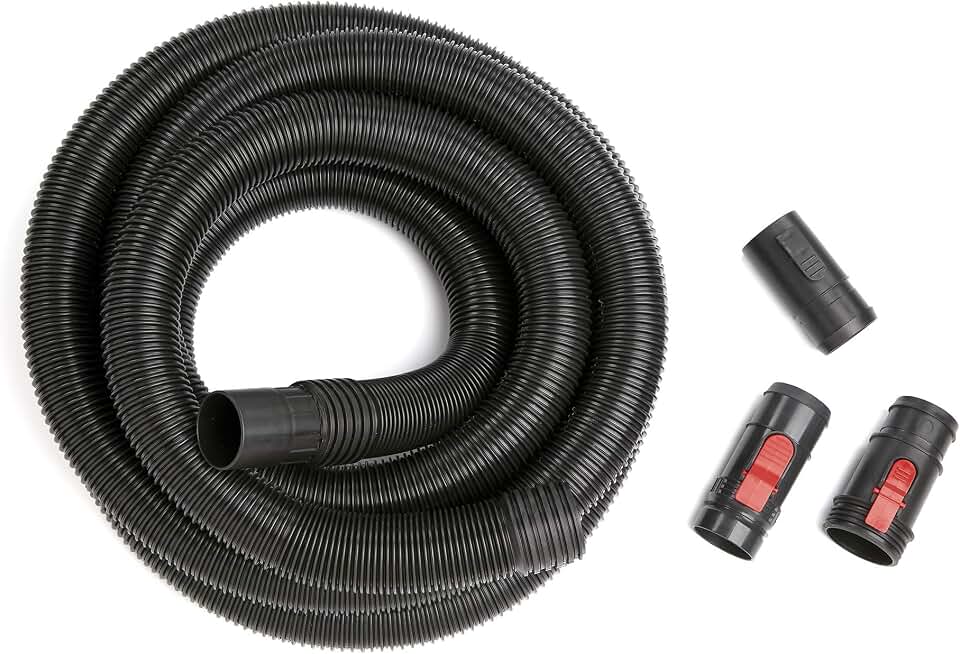
CRAFTSMAN 20 Foot POS-I-LOCK Hose
- Extra long twenty foot reach for large spaces
- POS-I-LOCK connection helps keep hose secure
- Two and a half inch size supports heavy debris
- Industrial-grade construction for demanding cleanup
- Fits most compatible CRAFTSMAN wet dry vacuums
Buy on Amazon
Choose the locking CRAFTSMAN connection only after checking the model list. A secure-looking cuff can still be mechanically incompatible if its tabs, groove position, or taper differ from the vacuum inlet.
Woodworking Dust-Collection Kits
A woodworking kit makes sense when one vacuum serves tools with several port sizes. The best dust collection hose kit includes measured adapters without reducing every connection to a narrow opening that catches curls and chips.
These kits provide 10-foot reach and several ways to connect a shop vac hose near the dust source.
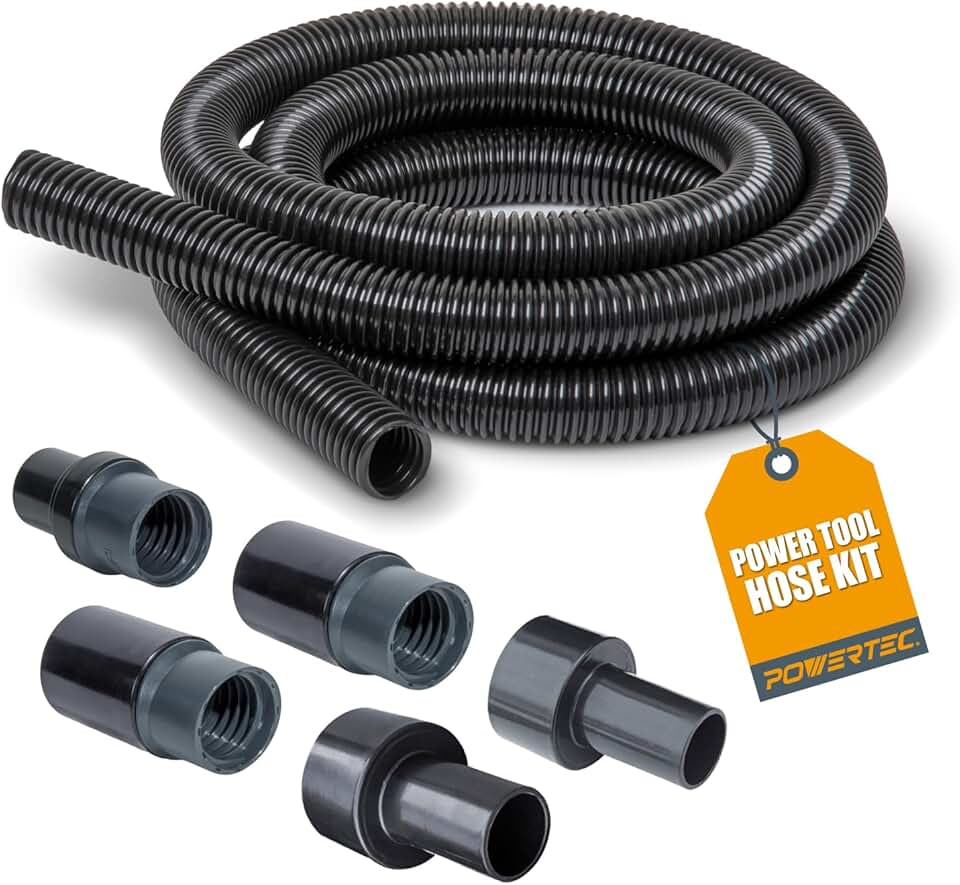
POWERTEC 10 Foot Dust Hose Kit
- Ten foot hose extends dust collection reach
- Includes five fittings for versatile connections
- Supports woodworking power tool cleanup
- Works with home and wet dry shop vacuums
- Helps keep sawdust closer to the source
Buy on Amazon

POWERTEC 10 Foot Shop Vac Hose Kit
- Ten foot hose offers convenient tool reach
- Built for woodworking dust collection tasks
- Connects with wet dry work shop vacuums
- Useful for miter saw and table saw cleanup
- Helps maintain a cleaner work area
Buy on Amazon

Universal 10 Foot Power Tool Hose Kit
- Ten foot hose adds flexible cleanup reach
- Made for dust collection at power tools
- Supports multiple tool types and brands
- Helps capture debris near the source
- Ideal for organized workshop setups
Buy on Amazon
For table saw dust collection, inspect the saw’s lower port and the openness around the blade. A narrow shop vacuum connection can work on a portable saw, but it can’t move enough air across a large cabinet opening or collect every particle thrown above the table.
Compact Multi-Brand Hoses
Compact shop vac hoses feel light at the tool and slip around bench legs without fighting the operator. Their narrow passage is prone to blockage from long shavings, offcuts, and packed planer chips.
These options cover short replacement, extended reach, and multi-brand adapter needs.

Heavy-Duty 4 Foot Shop Vac Hose
- Four foot replacement hose for compact setups
- One and a quarter inch flexible vinyl design
- Compatible with Shop-Vac 9196300 models
- Supports home and workshop cleaning
- Heavy-duty build handles everyday vacuuming
Buy on Amazon
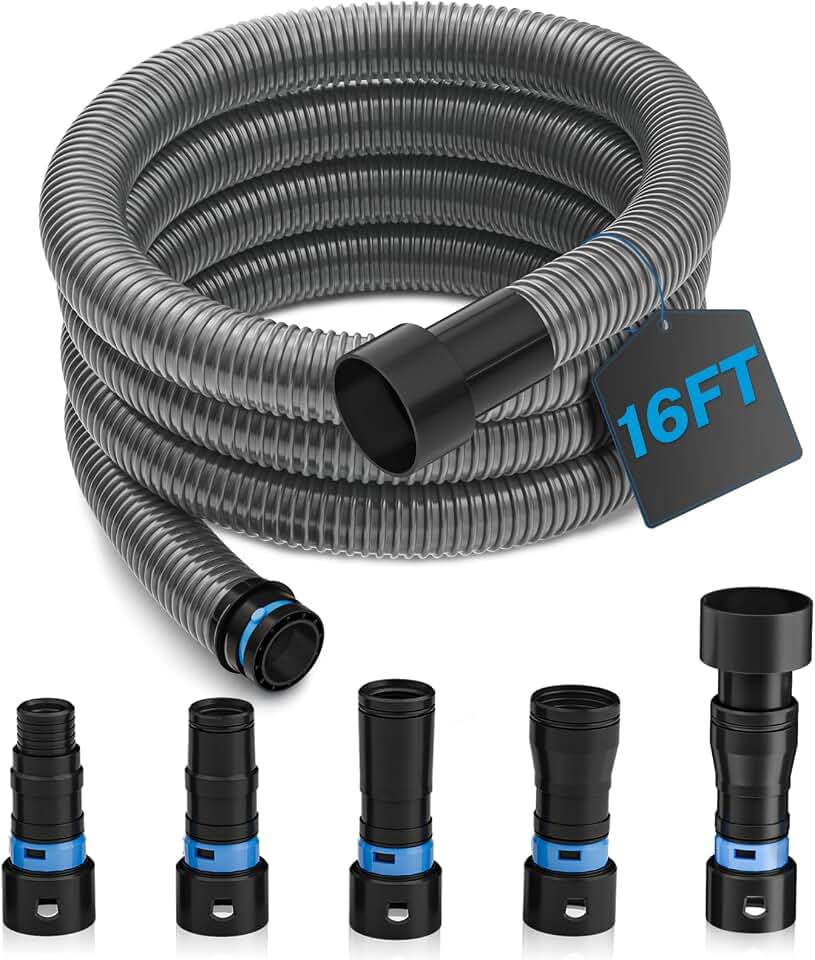
Hon and Guan 16 Foot Vac Hose Kit
- Sixteen foot hose reaches across larger spaces
- Quick-connect adapters simplify setup changes
- One and a quarter inch flexible hose design
- Multi-brand adapters support home and shop vacs
- Adapter range fits one and a quarter to two and a quarter inch connections
Buy on Amazon

IWIWE 10 Foot Replacement Vacuum Hose
- Ten foot replacement hose improves cleaning reach
- One and a quarter inch diameter suits compatible vacuums
- Two and a quarter inch cuff supports secure connections
- Compatible with select Shop-Vac Craftsman and Ridgid models
- Upgraded seal and durable construction support reliable use
Buy on Amazon
A “multi-brand” label describes the supplied adapters, not a single standard shared by all vacuums. Compare the supported model numbers, since RIDGID, CRAFTSMAN, and Shop-Vac connections may use different locking features despite similar diameters.
Testing, Warranty, and Pricing
Product claims should be checked with cuff measurements, fit tests, bend tests, and debris pickup before ranking one hose above another. The recommendations above rely on supplied specifications, not a controlled test of every product.
Practical notes from use: a good hose bends into a broad arc without folding flat, stays attached when pulled around a bench, and doesn’t emit a sharp whistle. Stiff ribs scraping concrete produce a hollow rattle, while a hidden split often makes a thin hiss that becomes easier to hear after blocking the open end for a second.
- Measure cuff inside and outside diameters with calipers.
- Check the extended working length rather than relying on the boxed coil.
- Drag the hose around one corner to test cuff retention.
- Pick up fine sawdust, short chips, and a few larger curls separately.
- Compare suction at the vacuum inlet, bare hose, and final adapter.
- Read warranty exclusions for wear, wet pickup, and commercial use.
Basic short replacements often fall near $15–$35, 8- to 10-foot heavy hoses near $25–$60, and long hoses near $35–$80. Premium antistatic tool hoses can exceed $150, so compare included cuffs and warranty coverage rather than hose length alone.
Shop Vac Hose Sizes and Compatibility
Shop vac hoses aren’t universally interchangeable. Confirm the vacuum-side cuff, tool-side cuff, locking style, and hose-body diameter before purchase.
Common Hose Diameters
The common nominal sizes are 1-1/4, 1-7/8, and 2-1/2 inches. Four-inch hose belongs mainly to conventional woodworking collectors and shouldn’t be treated as a direct shop-vac replacement.
| Nominal diameter | Approximate area | Typical use | Main limitation |
|---|---|---|---|
| 1-1/4 in | 1.23 sq in | Sanders, track saws, detail nozzles | Clogs on large chips |
| 1-7/8 in | 2.76 sq in | Mid-size wet/dry vacuums | Fewer cross-brand fittings |
| 2-1/2 in | 4.91 sq in | Floor cleanup and larger saw ports | Heavy near handheld tools |
| 4 in | 12.57 sq in | Dust collectors and stationary machines | Too large for most shop vacuums |
Nominal Versus Actual Size
A nominal measurement may describe the hose bore, outside wall, cuff, inlet, or accessory family. A hose sold as 2-1/2 inches can still need a reducer or proprietary locking cuff.
Measuring Ports and Cuffs
Disconnect the vacuum, then measure a male port’s outside diameter and a female socket’s inside diameter. Record the insertion depth, taper at both ends, and any groove or locking tab to the nearest 1/16 inch or millimeter.
- Measure the vacuum inlet and identify whether it is male or female.
- Measure the hose cuff at the actual mating surface.
- Repeat the process at the tool port and compare the figures with a product drawing.
Cuff Connection Types
Friction-fit cuffs change tools quickly but can loosen as a hose twists. Twist-lock, snap-lock, POS-I-LOCK, and threaded cuffs hold more securely, yet their tabs and thread pitches reduce cross-brand compatibility.
Universal Fit Claims
“Universal” usually means a kit includes several tapered adapters. It doesn’t mean every hose connection shares one diameter, thread, swivel, seal, or electrical property.
Brand and Model Checks
Read the manufacturer’s fit chart and inspect your existing cuff before ordering. Reusing a removable OEM cuff can solve a brand-specific connection, provided the replacement hose has a matching wall diameter, rib pitch, and thread direction.
Choose Diameter and Hose Length
Choose the widest hose that the vacuum, tool port, and debris load can use without losing useful air velocity. Keep the run as short as practical, since length, corrugations, bends, and reducers all consume pressure.
Small-Diameter Hoses
A 1-1/4-inch hose feels nimble behind a sander, router, or track saw and maintains high velocity through a restrictive port. It has only 1.23 square inches of area, so shavings bridge easily at a tight bend or adapter ledge.
2-1/2-Inch Hoses
A 2-1/2-inch hose provides about four times the area of a 1-1/4-inch passage. That lowers clogging risk during floor cleanup and large-chip pickup, but it doesn’t prove four times the airflow because the motor, filter, cuffs, and tool opening still limit the system.
Length and Suction Loss
Four feet works well for fixed connections, 8–10 feet covers most benches, and 16–20 feet favors reach. A long corrugated hose creates more friction, feels heavier at the cuff, and becomes a trip hazard when unused coils stay on the floor.
Airflow Area and Velocity
Cross-sectional area follows π × radius². At a theoretical 4,000 feet per minute, round passages would carry about 34 CFM through 1-1/4 inches, 136 CFM through 2-1/2 inches, and 349 CFM through 4 inches; these are geometric calculations, not measured vacuum output.
Static Pressure Versus CFM
A shop vacuum develops relatively high static pressure through small ports, while a conventional collector moves more CFM through larger ducts. That difference explains why vacuums suit sanders and track saws, while collectors fit planers, jointers, and open saw cabinets better than peak-horsepower labels suggest.
Hose Construction and Durability
Hose durability depends on wall material, rib structure, cuff attachment, temperature, and bend stress. A thicker hose may resist crushing yet feel tiring and stiff beside a handheld tool.
Flexible Vinyl Hose
Vinyl hose is affordable, easy to coil, and suitable for routine cleanup. Thin walls can kink near cuffs, and cold vinyl often feels hard and springy instead of settling into a relaxed curve.
Crush-Resistant Hose
Reinforced ribs help a hose recover after a shoe or cart wheel flattens it. Treat “heavy-duty” as a marketing description until the seller provides wall construction, recovery data, material details, or meaningful warranty coverage.
Smooth-Bore Versus Corrugated
A smooth bore reduces turbulence and gives shavings fewer ledges to catch. Flexible vacuum hose needs corrugations to bend, so use smooth rigid duct for longer fixed routes and reserve flexible hose for the final machine connection.
Antistatic and Conductive Claims
Antistatic material, conductive hose, wire-helix hose, and ordinary plastic with an external wire aren’t interchangeable terms. Ask for electrical resistance data and continuity instructions; visible wire alone doesn’t make a system suitable for combustible dust.
Woodworking Extraction by Tool
Effective woodworking extraction matches the collector to the tool’s port restriction and debris volume. Use a shop vacuum for small source-capture ports and a high-CFM collector for machines that release chips into large enclosures.
Handheld Power Tools
Sanders, track saws, and small routers pair well with flexible narrow hose. A swivel and overhead support stop the hose from tugging sideways, which matters when a random-orbit sander should feel light and free rather than pinned by a heavy coil.
Fine sanding dust loads filters quickly, so connect a suitable bag and sealed fine-dust filter when the vacuum supports them. Extraction choices vary between a belt sander and a router table because their debris volume and port geometry differ.
Table Saw Dust Collection
Portable saws with a rear 2-1/2-inch dust port often work acceptably with a shop vac hose adapter. A large cabinet table saw usually needs higher airflow through a 4-inch lower port, plus overarm dust collection for particles thrown above the blade.
Closing cabinet gaps can improve lower capture, but don’t block motor cooling vents or moving parts. Splitting one small vacuum hose between the lower port and blade guard usually leaves both branches with weak capture.
Miter Saw Capture
A miter saw throws dust across a broad moving arc, so a hose upgrade alone rarely fixes the problem. Use a close-fitting hood, short routing, and minimal reductions without restricting bevel, slide, fence, or guard movement.
Planers and Jointers
Planers and jointers produce a continuous stream of bulky curls that can pack a narrow hose within seconds. A 4-inch collector connection is the better match for most machines, including a thickness planer or full-size jointer.
Shop Vac Versus Collector
Choose a shop vacuum for small, restrictive ports and one-tool mobile extraction. Choose a dust collector for high-volume chip production, 4-inch machine ports, and large capture openings.
| System | Pressure and airflow pattern | Best matches | Poor matches |
|---|---|---|---|
| Shop vacuum | High pressure, lower volume | Sanders, track saws, routers, cleanup | Open cabinets, planers, jointers |
| Dust collector | Higher volume, lower pressure | Table saw bases, planers, jointers | Tiny restrictive tool ports |
Build a Small Shop Dust Collection System

A practical small shop dust collection system may use a shop vacuum, a conventional collector, or both. The best layout keeps branches short, closes unused gates, separates chips before the filter where useful, and matches each machine’s port.
Shop Vacuum System
A vacuum-based system needs the correct hose, sealed cuffs, a suitable filter, and tool adapters. Add a collection bag and cyclone when approved, then operate one tool at a time to retain useful suction.
Dust Collector System
A conventional system uses a blower, impeller, filter, collection container, gates, and 4- or 6-inch ducting. Don’t reduce the main run to shop-vac size; low-pressure collectors lose much of their airflow through long narrow passages.
Hybrid Extraction System
A hybrid setup uses the vacuum for sanders, track saws, and portable routers, then reserves the collector for saw cabinets, planers, and jointers. This split handles pressure and volume needs without forcing every tool onto one pipe diameter.
Cyclones and Pre-Separators
A cyclone removes many chips before they reach the vacuum, reducing bag and filter loading. It also adds pressure loss, floor space, hose joints, and leak points; a thin collection bucket may buckle inward with a loud pop under vacuum.
Fine-Dust Filtration
Visible chip capture doesn’t prove that fine airborne dust stays contained. Use a correctly fitted fine-dust or HEPA filter, a compatible bag, and intact gaskets, recognizing that accepting a HEPA-labeled filter doesn’t make the full vacuum a certified HEPA system.
The NIOSH woodworking controls guide describes source capture and engineering controls for woodworking equipment. Respiratory protection and room air cleaning may still be needed where extraction can’t contain fine particles.
Adapters, Reducers, and Installation
Good installation preserves the largest useful passage and prevents hose strain. Place reducers near the tool, use gradual transitions where space permits, and avoid fittings that create internal ledges.
Reducers and Expanders
Every sudden diameter change creates turbulence and resistance. A reducer projecting deep inside the hose forms a chip-catching shoulder, so trim compatible tapered adapters carefully or select a molded transition with a smooth inner path.
Quick-Connect Fittings
Quick connectors save time when one vacuum serves several machines. Check the seal, release action, swivel freedom, and actual port range; a connector can feel locked while a small air gap whistles around the O-ring.
Clamps and Couplings
Worm-drive clamps work on suitable flexible cuffs, but excess torque can crack a plastic port or cut thin vinyl. Rubber plumbing couplings solve unusual mismatches if their dimensions and vacuum resistance suit the application; tape works better as a leak test than a permanent mechanical joint.
Tool-Port Connections
Support hose weight so the tool port doesn’t carry a long hanging run. An overhead loop or bench-mounted swivel gives strain relief while keeping the hose clear of blades, belts, fences, workpieces, and walking paths.
Branches and Blast Gates
Close unused branches because a shop vacuum has limited airflow to divide. Install gates where dust can’t pack behind the slide, and inspect them for edge leakage after collecting fine sawdust.
Troubleshooting Airflow and Safety
Test weak extraction one component at a time, starting directly at the vacuum inlet. Stop collecting any material that is hot, sparking, toxic, reactive, or outside the vacuum manufacturer’s approved uses.
Weak Suction
Check the tank or bag, filter, inlet, hose, cuffs, separator lid, and open branches in that order. Strong suction at the bare inlet but weak pickup after the hose points to a blockage, leak, or restriction downstream.
Whistling and Leaks
A sharp whistle often comes from a loose cuff, split rib, leaking swivel, or partly blocked adapter. Apply removable tape briefly to isolate the leak location, then replace or mechanically repair the failed part.
Repeated Clogging
Repeated clogs indicate a hose that is too narrow, a loaded filter, tight bends, low airflow, or an internal adapter step. Continuous planer curls and turning shavings call for a larger collector, not repeated poking with a stick that may puncture the hose.
Hose Retention
If a hose pulls off, reduce hanging weight, add support, or use the correct locking cuff and flexible adapter. Don’t crush a thin plastic dust port with an overtightened clamp.
Static Discharge
Dry wood dust moving through plastic can produce an abrupt sting at the cuff or a visible snap in a dark shop. Follow manufacturer-approved bonding instructions; an improvised wire may reduce nuisance shocks but doesn’t certify the system for hazardous dust.
Combustible Dust Safety
Wood dust is combustible, and an ordinary wet/dry vacuum isn’t an explosion-proof collector. Never collect hot ash, glowing debris, sparks, flammable liquids, or incompatible metal dust with a woodworking vacuum setup.
Review the vacuum manual, tool instructions, local fire rules, and OSHA combustible dust guidance before building fixed extraction. A wire helix, cyclone, or antistatic label doesn’t replace a proper hazard assessment.
FAQs
Are All Shop Vac Hoses Universal?
No, shop vac hoses are not all universal. Hose diameters, cuff styles, locking tabs, and tool connections vary by brand and model. Common sizes include 1 1/4, 1 7/8, and 2 1/2 inches, so check both connection points before buying a replacement hose or adapter.
What Size Shop Vac Hose Do I Need?
The right shop vac hose size matches your vacuum port and the tool or accessory you want to use. Measure the fitting diameter and compare it with the manufacturer’s specifications. Smaller hoses work well for detail cleanup, while 2 1/2-inch hoses move more debris for woodworking and larger cleanup jobs.
Does A Longer Shop Vac Hose Reduce Suction?
Yes, a longer shop vac hose can reduce suction at the tool end. Extra hose length creates more airflow resistance, especially when the hose has sharp bends or clogs. Use the shortest practical hose length and keep it as straight as possible for stronger pickup performance.
Can I Use A Shop Vac For Table Saw Dust Collection?
Yes, a shop vac can collect table saw dust when connected directly to the saw’s dust port. It works best for smaller saws and intermittent cutting, particularly with a fine dust filter or collection bag installed. For heavy, continuous cutting, a dedicated dust collector usually handles larger wood chips better.
How Do I Measure A Shop Vac Hose Fitting?
Measure a shop vac hose fitting by checking its diameter and whether it is male or female. Measure the outside diameter of a male fitting and the inside diameter of a female fitting using a ruler, tape measure, or calipers. Also check for locking tabs, threads, or tapered ends before choosing an adapter.


