


Shelf supports include cabinet pins, adjustable clips, fixed wall brackets, concealed rods, glass clips, and folding brackets. Choose them by shelf material, dimensions, mounting surface, adjustability, and the complete installed load rather than appearance or a bracket-only rating.
Table of Contents
Shelf Support Types Compared
The main shelf support types serve different jobs and rarely interchange safely. Pins fit cabinet holes, clips engage standards, angle brackets carry wall shelves, concealed rods fit thick floating shelves, and folding hardware supports movable work surfaces.
Support Identification Chart
| Appearance | Support name | Usual location | Identification detail |
|---|---|---|---|
| Small round stem with flat or spoon-shaped top | Shelf pin or peg | Cabinet or bookcase | Fits a 5 mm or 1/4-inch panel hole |
| Stamped clip with hooked rear tabs | Pilaster clip | Closet or pantry standard | Hooks into slots rather than round holes |
| Visible right-angle arm | Fixed angle bracket | Wall-mounted shelf | Vertical plate and horizontal shelf arm |
| Rod or thin backplate hidden by wood | Floating support | Decorative shelf | Requires drilled or routed shelf cavities |
| Hinged triangular mechanism | Folding bracket | Fold-down shelf or worktop | Has a release tab, lever, or sliding lock |
| Padded clip, lip, or clear cradle | Glass support | Display cabinet | Matches glass thickness and retention method |
Shelf Pins and Pegs
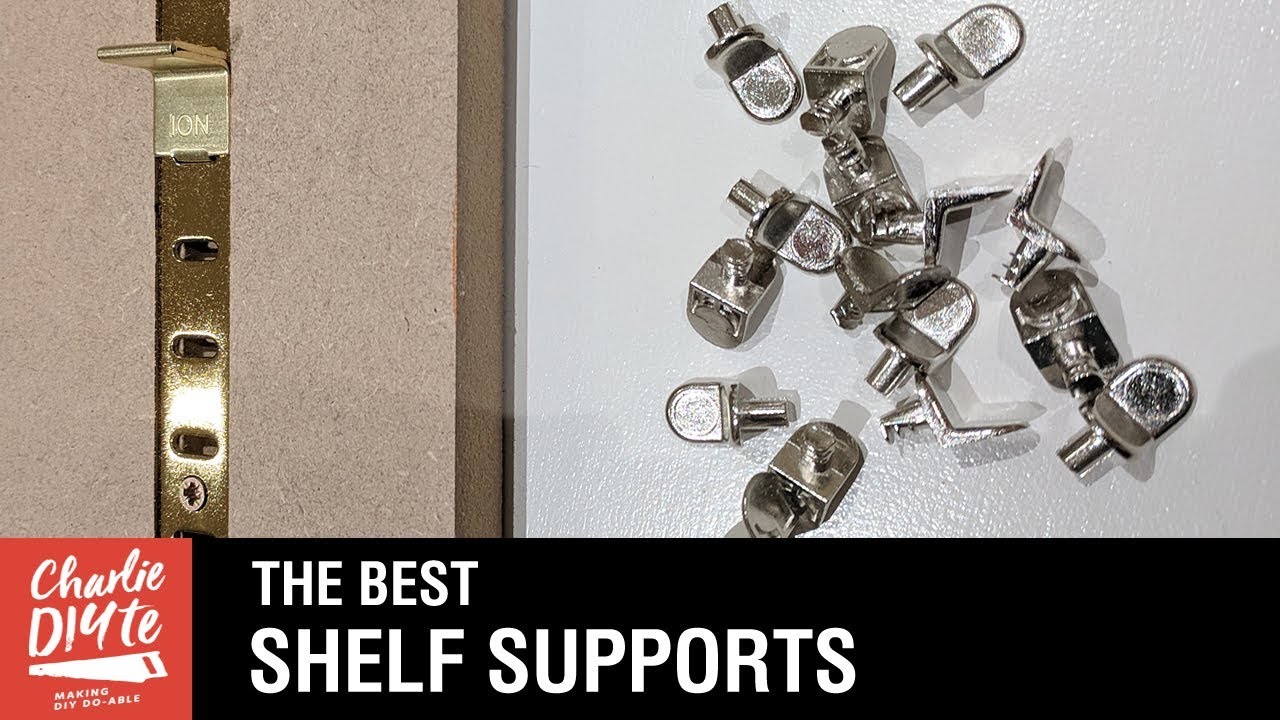
Shelf pins carry removable cabinet shelves at four matching hole positions. Spoon pegs offer a broad bearing surface, L-shaped pegs resist sideways movement, and locking styles capture the shelf for furniture that may be bumped or moved.
Push each pin fully home and check for downward tilt. A pin that rocks with a faint clicking sound often points to an enlarged hole, not a defective replacement peg; our guide to shelf pegs covers the common profiles in closer detail.
Adjustable Shelf Clips
Adjustable shelf clips connect to pilaster strips, slotted standards, or proprietary cabinet systems. Match the clip to the exact slot shape and standard series because two clips with similar hooks can seat at different depths.
Locking clips suit mobile storage and frequently handled shelves. Adhesive clips can steady a light divider, but the soft creeping feel of adhesive under sustained weight signals that it shouldn’t serve as the primary structural connection.
Fixed Angle Brackets
Fixed angle brackets provide a direct, economical wall-shelf connection. Steel versions suit utility storage, while wood and cast-metal designs trade some dimensional efficiency for a decorative appearance.
The bracket, screw, wall, and shelf act as one load system. A thick steel arm can remain straight while weak anchors pull from drywall or a particleboard shelf tears around its underside screws.
Concealed Floating Supports
Floating shelf supports hide rods or narrow arms inside the shelf. Selection depends on rod diameter, projection, backplate size, mounting-hole positions, shelf thickness, and the depth of the receiving bores.
Accurate drilling matters more than cosmetic fit. If one rod enters at a slight angle, the shelf may feel springy at the front and rotate under load; a drill guide or press produces a far cleaner fit than freehand drilling.
Glass and Adhesive Supports
Glass shelf supports need a pad, lip, clamp, or retainer sized for the glass. Bare metal against glass creates a hard contact point, while a resilient pad spreads pressure and stops the dry scraping sound that appears when glass shifts.
Use hardware approved for the stated glass thickness and edge type. Tempered glass can’t be drilled or trimmed after tempering, and adhesive pads should stabilize rather than carry substantial structural weight.
Shelf Support Comparison Table
| Support type | Adjustable | Visibility | Best use | Critical check |
|---|---|---|---|---|
| Pin or peg | Yes | Low | Cabinets and bookcases | Pin diameter and hole condition |
| Pilaster clip | Yes | Medium | Pantries and closets | Clip-to-standard profile |
| Fixed angle bracket | No | High | Books and utility storage | Wall attachment and arm depth |
| Floating support | No | Very low | Decorative wood shelves | Shelf thickness and bore accuracy |
| Folding bracket | Movable, not height-adjustable | Medium | Fold-down work surfaces | Lock, clearance, and pair alignment |
| Glass support | Often | Low | Displays and cabinets | Glass thickness and retention |
Shelf Support Sizes and Compatibility
Compatibility starts with measured dimensions, not product photos or cabinet style. Record hole diameter, shelf depth, thickness, unsupported span, and the support’s usable projection before buying a pack.
Critical Measurements
Digital calipers reveal differences that a tape measure can’t show clearly. Measure the metal stem itself, avoiding burrs and plastic sleeves, then check hole diameter, insertion depth, shelf thickness, shelf width, and wall-stud positions.
- Pin or peg diameter and usable stem length
- Hole diameter and signs of crumbling
- Shelf depth, width, and thickness
- Bracket arm and mounting-plate dimensions
- Unsupported span between supports
- Open, folded, and operating clearance
5 mm vs. 1/4-Inch Pins
These sizes differ: 5 mm equals about 0.197 inch, while 1/4 inch equals 6.35 mm. The larger pin is 1.35 mm wider, a conversion based on the exact 25.4 mm international inch documented by the National Institute of Standards and Technology.
A 5 mm peg in a 1/4-inch hole usually feels loose and may tip under load. Forcing a 1/4-inch peg into a 5 mm particleboard hole can leave a raised, crumbly rim and permanently weaken the panel.
Bracket Depth Guidelines
A bracket arm reaching about two-thirds of shelf depth is a useful starting point for many conventional shelves, not an engineering guarantee. A 12-inch shelf often pairs with an 8- to 10-inch arm, subject to the maker’s stated limits.
Short arms leave more front overhang and increase leverage at the wall connection. Deep shelves carrying appliances need closer scrutiny than shallow display ledges, particularly where people may lean on the outer edge.
Shelf Thickness Requirements
Shelf thickness affects stiffness, screw purchase, and concealed-rod clearance. Floating shelves must contain the rod with enough material above and below it, while bracket-mounted boards need enough screw depth without tips piercing the top face.
Material matters alongside thickness. Plywood usually holds screws better than particleboard, while MDF offers a smooth surface but can sag over a long span; see our threaded insert guide for removable connections in suitable sheet goods.
Replacement Shelf Pin Kit
A mixed replacement kit can repair several cabinets, but count only the pieces that fit your measured holes. Test one support at each damaged location before loading the shelf; mixed peg profiles may place the shelf at slightly different heights.

Versatile Shelf Pin Kit
- Includes 104 shelf support pieces
- Four practical peg styles for varied needs
- Nickel-plated finish offers lasting durability
- Fits 5 millimeter and quarter inch shelf holes
- Ideal for cabinets bookcases closets and kitchens
 Buy on Amazon
This assortment serves cabinet shelf repairs; it doesn’t replace a wall bracket, floating rod, or folding mechanism. Verify how many 5 mm and 1/4-inch pieces are included before judging value from the total 104-piece count.
Materials and Mounting Surfaces
The mounting surface often controls installed shelf capacity. Wood studs, blocking, masonry, metal studs, drywall, and cabinet panels need different fasteners and offer different resistance to pullout.
Shelf Material Differences
Solid wood, plywood, MDF, particleboard, glass, and metal deflect and hold fasteners differently. The USDA Wood Handbook explains how wood properties and moisture affect dimensional behavior, a key issue for shelves in kitchens, garages, and laundry rooms.
MDF feels dense and smooth at a fresh cut, yet its edges can turn fuzzy and weak after moisture exposure. Plywood resists sag well for its weight, while solid boards may cup if grain, moisture, and fastening don’t allow seasonal movement.
Studs and Blocking
Studs and blocking give wall screws solid material to grip. Confirm each location with a stud finder and a small verification hole, since common 16- or 24-inch layouts don’t prove where framing sits in a particular wall.
Fold-down worktops benefit from continuous plywood backing or blocking across both brackets. This lets the installer place matched brackets where the work surface needs them rather than accepting inconvenient stud spacing.
Masonry and Metal Studs
Masonry mounting needs anchors and drill bits matched to concrete, solid brick, hollow block, or mortar. Keep holes away from crumbling edges and clean drilling dust from the bore before setting the specified anchor.
Metal studs need an approved fastening plan based on stud gauge and shelf load. Heavy fold-down surfaces may require backing or engineered attachment rather than generic self-drilling screws through the stud flange.
Drywall Anchor Limitations
Drywall anchors may suit light, static shelves when the bracket maker permits them, but drywall isn’t equal to structural framing. Published anchor values also depend on board thickness, edge distance, installation quality, and load direction.
A front-loaded shelf pulls the upper fastener outward while pressing the lower part of the bracket into the wall. That prying action can loosen an anchor long before a steel bracket visibly bends.
Moisture-Resistant Finishes
Finish selection matters in bathrooms, laundry rooms, garages, balconies, and coastal areas. Indoor zinc plating or paint can stain orange around screw heads once the coating is scratched or condensation remains on the metal.
Choose stainless steel or a manufacturer-rated exterior coating where exposure demands it. Pair compatible fasteners with the bracket, since a corrosion-resistant bracket gains little from unprotected screws that rust into the wall.
Load Ratings and Bracket Spacing
A shelf’s safe load equals the capacity of its weakest installed component, not the largest number in a product title. Wall structure, fasteners, bracket spacing, shelf stiffness, load position, and movement all affect performance.
Installed System Capacity
System capacity includes the wall, anchor, screw, bracket, locking joint, shelf board, and board-to-bracket connection. Changing a tested stud-mounted screw to a hollow-wall anchor can invalidate the stated capacity.
Heavy, valuable, hazardous, or overhead items warrant a qualified assessment. No broad spacing chart can account for every wall condition, shelf material, fastener, and pattern of use.
Rating Claims to Verify
Before relying on a load claim, find the test setup in the manufacturer’s instructions. A number without mounting and loading conditions offers little guidance for a finished shelf.
- Is the rating per bracket, per pair, or per completed shelf?
- Was the test performed on studs, blocking, masonry, or a hollow wall?
- Which screws or anchors were used?
- What shelf depth and bracket spacing were tested?
- Was weight centered, evenly distributed, or applied at one point?
- Was the load static, repeated, or impact-based?
Uniform vs. Point Loads
Uniform loads, such as books spread across a shelf, usually stress the assembly more evenly than one heavy appliance. A concentrated object can overload the nearest bracket or create local bending in the board.
Dropping a tool, running a vibrating machine, or leaning on a worktop creates dynamic force beyond the object’s static weight. Never use a shelf as a seat, step, or handhold without a rating for that exact use.
Front-Edge Leverage
Front-edge loading increases the turning force at the wall. Moving the same object closer to the wall reduces that lever arm, often improving stability without changing the bracket or shelf.
This effect is easy to feel on a temporary test board: pressure near the wall feels firm, while the same hand pressure at the front produces more movement. Treat visible flex or fastener creaking as a stop signal.
Span, Sag, and Deflection
Unsupported span strongly affects sag. In the simplified formula δ = 5wL⁴ ÷ 384EI, span L is raised to the fourth power; doubling the span can produce about 16 times the deflection when all other conditions stay equal.
The formula describes an idealized, simply supported beam under a uniform load, so it isn’t a universal shelf rating. It does explain why adding a center support can produce a larger improvement than a modest increase in board thickness.
Bracket Spacing Guidelines
There is no universal spacing for shelf brackets. Place supports at structural attachment points, stay within the hardware maker’s maximum spacing, and shorten spans for thin sheet goods or dense loads such as books and tools.
Dry-fit the shelf and press gently along its length before loading it. A hollow drum-like sound between supports is normal, but visible bowing or a soft bounce calls for another bracket, a stiffer board, or a front-edge stiffener.
Folding Shelf Bracket Selection
A folding shelf bracket uses hinged arms and a positive lock to support a shelf in its open position, then releases so the surface can fold. Selection depends on lock style, dimensions, clearance, pair alignment, mounting structure, and real working loads.
Folding Bracket Types
A foldable shelf bracket may fold down from horizontal, lift upward, or support a drop-leaf edge. Triangular locking arms suit worktops, while compact hinges serve lighter shelves where folded projection matters more than capacity.
Terms vary across sellers: a collapsible shelf bracket, drop-leaf bracket, folding table bracket, and locking folding bracket may describe different motion paths. Read the dimensional drawing rather than relying on the listing title.
Locking Mechanisms
Positive locking should engage with a clear click and minimal side play. Common mechanisms use spring-loaded tabs, sliding arms, hinged triangles, or release levers positioned beneath the shelf.
Check whether both brackets must release at once. A wide shelf can put the controls beyond one person’s comfortable reach, causing the board to twist while one bracket remains locked.
Open and Folded Dimensions
Record the horizontal arm length, vertical plate, folded thickness, hinge position, open angle, and release-tab projection. Most work surfaces open near 90 degrees, but the product drawing must confirm the actual angle.
Folded thickness affects narrow corridors and cabinet clearances. Add the shelf board’s thickness and any handle or front stiffener to the bracket dimension when calculating the full folded projection.
Clearance Requirements
Operating clearance must account for pipes, outlets, baseboards, appliances, trim, and neighboring doors. Trace the shelf’s full motion with a cardboard template before drilling into a finished wall.
Leave hand space around release levers and keep the board edge from scraping the wall. A few millimeters of misjudged clearance can chip paint or prevent the lock from fully disengaging.
Pair Alignment and Spacing
Matched bracket alignment lets both mechanisms share weight and move together. Mount the pair level, parallel, and at equal projection using a rigid spacer or drilling template.
Misalignment makes one lock snap shut before the other, followed by a metallic scrape or shelf twist. Test each bracket alone, then connect the shelf and cycle the pair without weight.
Workbench Load Considerations
Collapsible shelf brackets can support a workbench only when the complete installation is rated for tools, impact, vibration, leaning forces, shelf depth, and bracket spacing. A high static figure doesn’t prove suitability for hammering or machinery.
Keep heavy tools nearer the wall and use structural backing across the bracket pair. For broader planning, compare fixed and movable surfaces in our guides to workbenches and a compact workshop table.
Pinch Points and Accessibility
Hinges and release tabs create pinch points during folding. Keep fingertips outside the triangular linkage, support the shelf with one hand, and release the controls only after removing loose objects.
Rounded front corners reduce injury risk in tight rooms. Accessible work surfaces also need project-based checks for height, reach, knee space, operating force, and local code rather than assumptions based on bracket dimensions.
Installation by Support Type
Correct installation starts with measurement and substrate verification. Use the hardware maker’s fasteners and instructions, then test movement and load in controlled stages before placing valuable items on the shelf.
Installing Cabinet Pins
Confirm that all four cabinet pins match in diameter, profile, and height. Insert them fully at identical hole rows, set the shelf down squarely, and check each corner for rocking.
Don’t mix a spoon peg with an L-shaped support where their bearing heights differ. Replace cracked plastic pieces and inspect particleboard dust around each hole before returning the shelf to service.
Installing Fixed Brackets
Mark a level line, locate structural attachment points, and drill suitable pilot holes. Fasten each bracket to the wall, recheck level, then secure the shelf through the bracket’s underside holes to resist sliding and uplift.
Use screw length that provides adequate embedment without striking hidden wiring or plumbing. A stud finder with electrical detection helps, but wall plans and cautious test holes remain useful checks.
Installing Floating Supports
Floating supports need straight, accurately spaced receiving holes. Transfer rod centers to the shelf with a template, drill with a guide or press, and stop before breaking through the face.
Dry-fit before adding approved adhesive or final fasteners. The shelf should slide on with firm, even resistance; forcing a crooked bore can split the rear edge or distort the mounting plate.
Installing Folding Brackets
Mount each folding bracket at the same height, projection, and orientation. Cycle both mechanisms before attaching the board, then open and close the assembled shelf without weight to detect rubbing or binding.
Use the video to visualize bracket movement, then follow the instructions supplied with your own model. Release direction, screw positions, wall requirements, and lock geometry differ across products.
Tools and Fasteners
A typical installation uses a drill-driver and level, tape measure, square, stud finder, pencil, suitable bits, clamps, and the specified screws or anchors. Floating systems may also need a drilling jig, long bit, or drill press.
Included generic anchors aren’t proof of substrate compatibility. Buy structural wood screws, masonry anchors, concrete screws, toggles, or metal-stud fasteners based on the wall and documented load requirements.
Final Load Testing
Begin with a no-load movement test, followed by small, evenly distributed increments. Watch bracket plates, upper fasteners, shelf edges, and locking joints for movement after each addition.
Stop if you hear cracking, repeated clicking, or gritty movement, or if the wall plate opens a visible gap. Testing doesn’t raise the manufacturer’s rating and shouldn’t use people as test weight.
Common Failures and Repairs
Common shelf failures come from size mismatch, weak attachment, excessive span, poor alignment, moisture, and front-edge loading. Repair the damaged connection or material rather than hiding movement with a larger load rating.
Wrong Pin Diameter
A 5 mm pin in a 1/4-inch hole may wobble or disengage, while a 1/4-inch pin can crush a 5 mm hole. Measure both an undamaged hole and the replacement stem rather than copying a loose old pin.
Enlarged Cabinet Holes
Enlarged shelf holes show as tilted pins, rocking corners, fine particleboard dust, or cracks around the opening. A new peg can’t restore missing panel material.
Use a suitable insert, rebuild the hole with a proven furniture-repair method, or relocate the support system. Don’t pack the opening with paper, tape, or soft filler that compresses under load.
Bracket Pullout
Bracket pullout often follows drywall-only attachment, short screws, damaged framing edges, or repeated front loading. Remove the shelf, inspect the wall cavity, and move to sound framing or install proper blocking.
Installing a larger anchor in a torn hole may enlarge the damage without fixing the load path. Repair the wall finish only after establishing a structural connection.
Shelf Sag
Shelf sag comes from excessive span, thin MDF or particleboard, humidity, dense loads, or too few supports. Add a center bracket, shorten the span, fit a front stiffener, reduce weight, or replace the board with a stiffer material.
Flipping a bowed shelf may hide the curve for a time, but it doesn’t correct the design. A shelf that has taken a permanent set usually bends again under the same loading pattern.
Floating Shelf Rotation
Floating shelf rotation points to loose wall attachment, short support rods, oversized bores, or inaccurate drilling. Remove the shelf and inspect both the wall plate and internal holes before adding adhesive.
Adhesive can’t compensate for a bracket plate pulling from the wall. Repair the structural attachment first, then correct shelf bores with the method approved for that shelf construction.
Folding Bracket Binding
Bracket binding usually comes from an out-of-parallel pair, warped board, paint or grit in the lock, or mismatched mechanisms. Remove the board and cycle each bracket separately to isolate the source.
Clean joints according to the maker’s directions and realign the pair with a rigid spacer. Don’t grind a locking tab or flood the mechanism with oil, since either step can change lock engagement.
Fastener Corrosion
Corroded fasteners lose section thickness and can seize inside brackets or anchors. Replace the affected hardware with a compatible exposure-rated set and correct the moisture source where practical.
Field-use notes: the first warning is often sensory rather than dramatic—a shelf begins to tick under hand pressure, a folding joint feels gritty, or rusty moisture marks appear below a screw. Unload and inspect at that stage instead of waiting for visible separation.
Cost and Purchase Checklist
Compare cost per completed shelf, not package price alone. Account for usable quantities, matched pairs, structural screws, anchors, drilling tools, blocking, shelf material, and finish work.
Pack Size and Unit Cost
Shelf-pin packs commonly contain roughly 20 to 120 pieces, while wall brackets may sell singly, in pairs, or in larger sets. Divide price by the number of supports that match your project, not the package total.
A 100-piece mixed assortment offers poor value if only 25 pegs fit. For brackets, calculate how many complete shelves the pack supports and whether each shelf needs two, three, or more mounting points.
Included Hardware
Check whether the package contains screws, anchors, pads, washers, release hardware, or mounting templates. Treat included fasteners as components to verify, not automatic matches for every wall.
Floating brackets may omit the shelf, while a folding-bracket listing may show two units but sell one. Read the quantity field and parts list before comparing offers.
Additional Tools and Blocking
Hidden project costs can include a long drill bit, shelf-pin jig, masonry bit, structural screws, plywood backing, wall repair, edge banding, and finish. Concealed supports often need more accurate tooling than visible angle brackets.
Opening a wall to add blocking can cost more than the brackets, yet it produces a far better connection for a deep fold-down work surface. Include patching and paint in the project estimate.
Manufacturer Specifications
Save the manufacturer specification sheet before purchase. Verify capacity basis, bracket quantity, wall construction, fasteners, spacing, shelf depth, shelf thickness, opening angle, folded size, finish rating, and warranty terms.
Marketplace descriptions can change or merge data from several sizes. Match the model number on the drawing to the exact size and finish in your cart.
Brands and Retailers
Häfele, Richelieu, Knape & Vogt, Sugatsune, Everbilt, ClosetMaid, Rubbermaid, and National Hardware offer different support hardware ranges. Home Depot, Lowe’s, Ace Hardware, Amazon, and specialist cabinet suppliers make comparison easier, but brand name alone doesn’t prove project compatibility.
Compare dimensional drawings, documented test conditions, replacement-part access, finish, and return terms. Customer photos can reveal scale and finish issues, yet they can’t verify an unseen wall connection.
Final Compatibility Check
Before ordering, confirm the support category first: cabinet pin, standard clip, fixed bracket, floating rod, glass support, or collapsible bracket. Products from different categories can look similar in small listing images but serve entirely different load paths.
- Measure every hole, shelf, bracket arm, and required clearance.
- Identify the shelf material and wall substrate.
- Confirm quantity per package and per completed shelf.
- Read whether the load rating applies per bracket, pair, or system.
- Verify fasteners, spacing, shelf depth, and loading conditions.
- Check moisture exposure and finish suitability.
- Test one replacement pin or dry-fit one bracket before committing to a large pack.
- Plan structural assessment for overhead, hazardous, valuable, or exceptionally heavy loads.
The safest purchase is the support whose dimensions and test conditions match the actual shelf, wall, and use. General depth and spacing rules provide a starting point, while manufacturer instructions and applicable building requirements set the final installation limits.
FAQs
What Types Of Shelf Supports Are Available?
Common shelf supports include shelf pins, fixed brackets, adjustable standards, cleats, floating-shelf rods, and heavy-duty metal brackets. Shelf pins work well inside cabinets, while brackets and standards are better for open wall shelving. Choose supports based on the shelf material, span, intended weight, and mounting surface.
Are 5 Mm And 1/4-Inch Shelf Pins Interchangeable?
No, 5 mm and 1/4-inch shelf pins are not reliably interchangeable because their diameters differ. A 1/4-inch pin measures about 6.35 mm, so it may not fit a 5 mm hole, while a 5 mm pin can sit loosely in a 1/4-inch hole. Always match pins to the cabinet’s existing holes.
How Far Apart Should Shelf Brackets Be?
Shelf brackets should usually be spaced 16 to 24 inches apart for most household shelves. Use closer spacing for long shelves, heavy loads, or weaker shelf materials such as particleboard. Position brackets near the shelf ends, and mount them into wall studs whenever possible for the strongest installation.
How Much Weight Can Shelf Supports Hold?
Shelf supports can hold anywhere from a few pounds to several hundred pounds, depending on their type, size, material, and installation. The shelf board, wall anchors, and mounting surface can limit capacity as much as the supports themselves. Check the manufacturer’s load rating and distribute weight evenly across the shelf.
Can A Collapsible Shelf Bracket Support A Workbench?
Yes, a heavy-duty collapsible shelf bracket can support a workbench when it is rated for the intended load and mounted securely. Use multiple brackets, install them into wall studs or solid masonry, and choose a thick, rigid work surface. Avoid relying on drywall anchors alone for a workbench.


