


Workbenches are stable work surfaces built for repair, assembly, woodworking, electronics, mechanical work, and DIY projects. The right bench depends on the workbench top, size, height, load rating, storage, power access, and how much force you’ll put into the surface.
A good bench feels steady when you lean into it, with no hollow rattle, side sway, or sharp vibration through your hands. A poor bench may look strong in photos, but loose bolts, thin tops, weak casters, and shallow frames make it frustrating once clamps, vises, tools, and real projects hit the surface.
Table of Contents
What Are Workbenches?
A workbench is a purpose-built work surface with enough stiffness, mass, and support to handle tools, parts, clamps, and repeated pressure. Workbenches range from simple garage benches to woodworking benches with vises, industrial stations with drawers, and electronics benches with ESD-safe tops.
Workbench Definition
Workbench definition: a workbench is a stable table-like station used to hold materials while you cut, drill, repair, assemble, solder, clamp, glue, sand, inspect, pack, or finish work. The bench may include a workbench top, steel frame, drawers, pegboard, power strip, task light, vise, bench dogs, or lower shelf.
The key difference from a normal table is resistance to force. A kitchen table can hold weight, but it usually hates hammer blows, clamping pressure, oil, sawdust, and a bench vise hanging off one corner.
Workbench vs Work Table
A work table is usually a flat surface for layout, light assembly, packing, or crafts. A workbench is built for heavier shop use, so it may have a thicker top, stronger frame, clamping options, storage, power access, leveling feet, or vise support.
The practical test is simple: push hard on the front corner. If the unit skates, twists, or clicks through the joints, it’s acting like a work table, not a true bench for planing, prying, or heavy repairs.
Work Bench Terms
Work bench, workbench, shop bench, workbench table, and workshop bench often describe the same product category. The search phrase “work work bench” usually appears as a typo or repeated-word query, so it’s better to compare real features than rely on naming alone.
- Workbench top: the main working surface, often wood, MDF, plywood, steel, stainless steel, laminate, or ESD laminate.
- Workbench tops: replacement or standalone surfaces used to rebuild an old bench frame or create a custom station.
- Woodworking benchtop: a thick, clamp-friendly top built for vises, bench dogs, hand planes, and holdfasts.
- Bench dogs: pegs that fit into holes to hold boards for planing, sanding, routing, and assembly.
- Holdfasts: clamping tools that lock into dog holes, often used on traditional woodworking benches.
- Racking: side-to-side frame twist, often felt when a bench wobbles during planing or hammering.
Workbenches by Use Case
Best workbenches match the task first, then the room. A garage bench, woodworking bench, portable woodworking bench, industrial bench, and electronics bench may all look similar online, but each handles force, storage, spills, static, and clamping in different ways.
Garage Workbenches
Garage workbenches suit household repairs, auto work, tool storage, lawn-equipment service, painting, sharpening, and general DIY. Most use a steel frame with a wood, rubberwood, MDF, butcher block, or laminate top, plus a lower shelf, pegboard, drawers, power strip, or LED light.
A 48-inch bench fits tight garages, while 60 inches gives room for a vise, cordless-tool charger, and active project space. Watch garage floor slope; a bench that feels solid on a showroom floor may rock on concrete that drains toward the door.
Woodworking Benches
Woodworking benches need mass, stiffness, and clamping access more than shelves or decorative pegboards. A good woodworking benchtop supports planing, chiseling, routing setup, joinery, carving, sanding, and glue-ups without skidding across the floor.
Look for a thick hardwood top, front vise, end vise or tail vise, dog holes, and enough overhang for clamps. If you already use a router station, a stable bench pairs well with a dedicated router table because layout, trimming, and test cuts need a flat support area close by.
Portable Woodworking Benches
A portable woodworking bench works well for renters, job sites, balconies, small sheds, and garages that still need to park a car. Folding legs, clamp slots, bench dogs, and sawhorse modes make these benches useful for cutting trim, sanding parts, repairing doors, and holding sheet goods briefly.
The trade-off is lower mass. You can feel the difference when a hand plane chatters across a board or a jigsaw sends a buzz through the frame, so use portable benches for controlled clamping and support rather than heavy chopping.
Industrial Workbenches
Industrial workbenches serve warehouses, maintenance rooms, assembly lines, packing stations, machine shops, labs, and production cells. These benches often offer steel frames, high load ratings, modular risers, drawers, bin rails, lights, laminate tops, maple tops, stainless surfaces, phenolic tops, or ESD options.
Industrial listings tend to define capacity more clearly than low-cost consumer benches, but check whether the number means evenly distributed static load. A motor, vise, or press placed near one corner stresses the frame differently than boxes spread across the full top.
Electronics Workbenches
Electronics workbenches favor clean surfaces, small-parts control, lighting, cable routing, grounded power, and static protection. For circuit boards, computer repairs, soldering, and sensor work, an ESD-safe mat or ESD laminate top helps reduce electrostatic discharge risk; the ESD Association standards explain how grounding systems and work surfaces fit together.
Beginners often mount soldering stations and power strips where wire clippings, flux, dust, or spilled coffee collect. Keep power access above the active mess zone, and add a heat-resistant pad under irons, hot-air tools, and small rework plates.
Type Comparison Table
| Workbench type | Best for | Common size | Typical top material | Load capacity range | Storage options | Portability | Price range |
|---|---|---|---|---|---|---|---|
| Garage workbench | DIY, repairs, tools, auto tasks | 48–72 in wide | Rubberwood, MDF, butcher block, laminate | 500–2,500 lb | Shelf, drawers, pegboard | Low to medium | $150–$1,200 |
| Woodworking bench | Planing, joinery, chiseling, clamping | 60–96 in wide | Hardwood, beech, maple | 500–2,000 lb | Tool well, shelf, vise storage | Low | $300–$2,000+ |
| Portable woodworking bench | Small spaces, job sites, light woodworking | 24–48 in wide | Composite, MDF, plastic, aluminum | 300–1,000 lb | Limited | High | $80–$250 |
| Folding workbench | Repairs, cutting support, temporary work | 24–48 in wide | Plastic, MDF, composite | 300–1,000 lb | Minimal | High | $80–$300 |
| Industrial workbench | Production, maintenance, packing | 60–96+ in wide | Maple, laminate, steel, phenolic | 1,500–5,000+ lb | Drawers, risers, bins, cabinets | Low to medium | $500–$3,000+ |
| Electronics workbench | Soldering, computer repair, circuit work | 48–72 in wide | ESD laminate, laminate | 300–1,500 lb | Bins, shelves, cable trays | Low | $300–$2,000+ |
| Metalworking workbench | Grinding, mechanical repair, metal layout | 48–96 in wide | Steel, hardwood with metal plate | 1,000–3,000+ lb | Drawers, lower shelf | Low | $300–$2,500+ |
| Packing workbench | Shipping, labeling, assembly | 60–96+ in wide | Laminate, maple, steel | 500–2,000 lb | Roll holders, shelves, bins | Low | $300–$2,000+ |
Choose a Workbench Top

The workbench top controls how the bench feels under tools, clamps, glue, oil, heat, and impact. Choose the surface by task: wood for clamping and repair, MDF for flat budget work, plywood for DIY strength, steel for mechanical work, stainless for wet cleanup, laminate for packing, and ESD laminate for electronics.
Hardwood Workbench Tops
Hardwood tops are the best all-around choice for woodworking, assembly, clamping, repairs, and general shop use. Maple, beech, oak, birch, and rubberwood all handle dents better than MDF, and most can be sanded, scraped, oiled, waxed, or refinished after years of abuse.
A hardwood work bench top gives clamps a warmer, grippier feel than steel; boards don’t skate as easily, and dropped tools land with a dull thud instead of a sharp clang. Seal rubberwood or oak in humid garages because open grain and end grain can drink moisture fast.
MDF Workbench Tops
MDF workbench tops are flat, cheap, and useful as sacrificial surfaces for crafts, model building, assembly, glue-ups, and light cutting. The weak points are moisture swelling, crushed edges, poor screw holding, and sag across long unsupported spans.
Seal the edges with paint, shellac, polyurethane, or glue size before the bench sees damp air. For messy work, add replaceable hardboard or thin plywood on top so you can refresh the surface instead of replacing the whole bench.
Plywood Workbench Tops
Plywood tops make sense for DIY benches, shop carts, outfeed tables, and budget shop stations. One 3/4-inch sheet works for light duty, but two laminated layers create a stiffer 1.5-inch workbench top with better screw holding and less bounce.
Cabinet-grade plywood stays flatter than construction plywood, which may twist, cup, or show voids at the edge. If your bench supports drilling fixtures or a small press, a plywood top can pair well with a shop-made drill press table setup.
Steel Workbench Tops
Steel workbench tops handle oil, grease, metal parts, bearings, small engines, and mechanical repair better than wood. The hard surface cleans fast and resists many dents, but it can rust, feel cold, scratch delicate parts, and damage woodworking edges.
Don’t assume every steel-topped bench works for welding. Welding needs fire-safe support, proper grounding, safe clearance, and a surface that won’t trap flammable dust, oil, rags, or solvent residue under the work.
Stainless Steel Tops
Stainless steel tops suit labs, food-adjacent spaces, gardening benches, utility rooms, wet cleanup, paint mixing, and messy repair areas. They resist moisture and wipe clean easily, but they scratch, dent, reflect glare, and cost more than MDF, rubberwood, or basic laminate.
The surface feels slick under wood parts, so use rubber mats or bench pads for delicate projects. A stainless top is easy to clean, but edge quality matters; cheap folded corners can feel sharp against wrists during long assembly sessions.
Laminate and ESD Tops
Laminate tops are common on packing benches, office-shop hybrids, assembly tables, electronics benches, and light production stations. They wipe clean, resist light shop grime, and give a smooth writing surface, but edge chips spread if heavy parts bang into corners.
ESD tops add static-control properties for electronics repair and circuit-board work. They cost more than basic laminate and need grounding cords, wrist straps, mats, and tested connections to work as a system rather than decorative surface material.
Workbench Top Thickness
Workbench top thickness affects stiffness, clamp bite, vise mounting, screw holding, and sag resistance. Light-duty tops may be 3/4 inch, general-purpose tops often run 1 to 1.5 inches, and serious woodworking benches commonly use 1.75 to 3 inches or more.
Thickness alone doesn’t decide strength. A thin top over close steel supports may feel firmer than a thick slab spanning too far between rails, so check material, frame spacing, fasteners, and load location before trusting the number.
Material Comparison Table
| Material | Best use | Durability | Moisture resistance | Clamp compatibility | Maintenance | Price level |
|---|---|---|---|---|---|---|
| Hardwood | Woodworking, repairs, assembly | High | Medium when sealed | Excellent | Oil, wax, sand, refinish | Medium to high |
| Rubberwood | Garage benches, budget hardwood tops | Medium to high | Medium when sealed | Good | Seal and avoid standing water | Medium |
| Maple | Premium butcher block, industrial benches | High | Medium when sealed | Excellent | Oil, wax, resurface | High |
| Beech | Traditional woodworking benches | High | Medium | Excellent | Oil, wax, flatten when needed | High |
| Oak | Garage and shop benches | High | Medium when sealed | Good | Seal open grain | Medium to high |
| MDF | Flat budget tops, sacrificial surfaces | Low to medium | Low | Fair | Seal edges, replace when swollen | Low |
| Plywood | DIY benches, shop-made tops | Medium to high | Medium when sealed | Good | Seal, patch, replace skin | Low to medium |
| Steel | Mechanical and metal work | High | Medium unless coated | Fair | Prevent rust, use mats | Medium to high |
| Stainless steel | Wet, clean, lab, garden work | High | High | Fair | Clean with non-abrasive products | High |
| Laminate | Packing, assembly, light shop work | Medium | Medium to high | Fair | Protect edges and avoid heat | Medium |
| ESD laminate | Electronics and static-sensitive work | Medium | Medium | Fair | Ground and test ESD path | High |
Workbench Size and Ergonomics

Workbench size should fit the room, the user, and the work style. Width controls layout space, depth controls reach, and height controls body strain; poor sizing causes sore wrists, tight shoulders, and that familiar lower-back pull after a long sanding or assembly session.
Common Workbench Widths
Common widths are 48, 60, 72, and 96 inches. A 48-inch bench fits compact garages and apartments, 60 inches suits most home shops, 72 inches gives better layout room, and 96 inches or longer works for cabinetry, packing, and multi-tool stations.
Leave open space for clamps, drawers, and long boards swinging past the bench end. A 72-inch bench squeezed between shelves can feel smaller than a 60-inch bench with clear side access.
Common Workbench Depths
Common depths are 20–24 inches for wall benches, 24–30 inches for most garage workbenches, and 30–36 inches for assembly tables reached from both sides. Depth feels different in real use because your body, wall, pegboard, and upper shelf limit reach.
A wall bench deeper than 30 inches often creates a dead strip at the back where screws, pencils, and small tools disappear. If you need a deep assembly surface, place it in the open so you can walk around it.
Common Workbench Heights
Common heights are 28–32 inches for seated or heavy-force work, 33–36 inches for general use, 36–39 inches for garage repair and assembly, and 38–42 inches for precision tasks such as electronics, model work, and detail sanding.
Height affects how force enters the bench. A lower bench lets your body weight press through a plane or chisel, while a higher bench brings small parts closer to your eyes and reduces neck bending.
Ergonomic Height Rules
Ergonomic rule: lower the bench for heavy force, raise it for detail work, and use adjustable height when several people share the same station. Standing work guidance from CCOHS supports matching surface height to task demand and posture.
For hand-tool woodworking, a bench around wrist height can feel natural for planing; for soldering or carving, closer to elbow height reduces hunching. If your shoulders lift while working, the bench is too high; if your back rounds, it’s too low.
Size Guide Table
| Bench size | Best for | Pros | Limitations |
|---|---|---|---|
| 48 x 24 inches | Small garages, apartments, light repairs | Fits tight spaces, easy to place against a wall | Limited room for vises, chargers, and large projects |
| 60 x 24 inches | Most garage and hobby shops | Good balance of space and reach | May still feel tight for cabinet parts |
| 72 x 24 inches | Large garage workbenches, tool layouts | More room for storage and assembly | Needs wall space and stronger frame support |
| 72 x 30 inches | Assembly, woodworking, multi-use shops | Better project support | Hard to reach back if placed against a wall |
| 96 inches or longer | Industrial, packing, cabinetry, shared stations | Large work zone and accessory room | Heavy, costly, harder to move and level |
Load Capacity and Stability
Load capacity tells you how much weight a workbench can support under stated conditions, but stability tells you how it behaves when you hammer, clamp, pry, plane, or drop a part. A 2,000 lb rating doesn’t guarantee a bench won’t wobble during side pressure.
Static vs Working Load
Static load usually means weight sitting still and spread evenly across the top. Working load includes movement, impact, vibration, leverage, vise pressure, and shifting weight, which stress bolts, rails, welds, caster plates, and the workbench top very differently.
A bench rated at 2,000 lb may hold boxes calmly but shake when you chop a mortise or tighten a pipe in a vise. The difference is dynamic force, and it’s why frame geometry matters as much as the number in the listing.
Duty-Level Ranges
Light-duty benches usually support about 300–500 lb, medium-duty benches about 500–1,500 lb, and heavy-duty workbenches about 1,500–3,000 lb or more. Many garage benches advertise 2,000 lb capacity, while some larger oak or steel-frame options reach 2,500 lb.
For real use, don’t buy at the edge of your expected load. A bench used with a vise, grinder, press, or engine part should have capacity headroom and a frame that resists racking, not just vertical weight.
Stability Features
Stable workbenches use wide frames, cross-bracing, thick tops, leveling feet, heavy bases, anti-rack panels, lower shelves, good fasteners, and solid height-lock mechanisms. On mobile benches, caster quality matters because tiny flex in the wheel stem becomes obvious when you push sideways.
- Leveling feet fix small garage-floor dips and stop diagonal rocking.
- Cross-bracing reduces side sway during planing, sanding, and prying.
- Lower shelves add weight low in the frame and help the bench feel planted.
- Wall anchoring improves safety for tall pegboard benches and top-heavy storage.
- Locking casters help mobility, but fixed legs still feel steadier under force.
- Thick tops improve clamp bite and reduce bounce between frame rails.
Real-World Failure Points
Practical notes from real-world use: most bench failures start small. The first signs are a faint click under side pressure, a drawer that rubs after loading, a pegboard that bows, a top that drums under hammer taps, or a caster that no longer locks square.
Beginners often mount a vise through a thin top without backing plates. Use large washers, steel plates, or hardwood blocking under the top so vise bolts don’t crush MDF, split plywood edges, or pull through rubberwood during hard clamping.
This video fits the setup stage because many wobble problems come from assembly, leveling, and fastener sequence rather than the bench design alone.
![Best Portable Workbenches 2026 [Find Which is Right for YOU?]](https://tools.glamorwood.com/wp-content/cache/flying-press/58f33e8759962fca87a31a8af5ff036d.jpg)
Load Capacity Table
| Capacity range | Duty level | Suitable tasks | Caution |
|---|---|---|---|
| 300–500 lb | Light-duty | Crafts, small repairs, light tools, model work | May wobble with vises, hammering, or heavy clamps |
| 500–1,500 lb | Medium-duty | Garage repairs, assembly, tool storage, general DIY | Check frame bracing and unsupported top span |
| 1,500–3,000 lb | Heavy-duty | Mechanic work, heavy parts, vises, shop fixtures | Rating may be static and evenly distributed |
| 3,000 lb+ | Industrial-duty | Production, maintenance departments, heavy equipment | Floor strength, anchoring, and loading method matter |
Workbench Features Buyers Compare
Workbench features should solve actual workflow problems, not just fill the product photo. Storage, outlets, lights, casters, pegboards, clamps, and vises all help when placed correctly, but they can create clutter, hazards, or weak points when added without planning.
Storage and Pegboards
Storage options include lower shelves, drawers, cabinets, pegboards, hooks, bins, side rails, and upper shelves. Pegboards keep hand tools visible, but they shouldn’t carry heavy grinders, drills, or impact tools unless the board and frame are reinforced.
Keep frequently used tools between shoulder and waist height. Heavy items belong low, where they add base weight and reduce tipping risk rather than turning the pegboard into a top-heavy sail.
Power and GFCI Safety
Built-in power is convenient for chargers, lights, rotary tools, soldering stations, and small benchtop machines. Many household circuits are 15 or 20 amps; a 15-amp 120-volt circuit equals 1,800 watts in theory, and garage receptacles often need GFCI protection under electrical code guidance such as NFPA 70.
Check for UL, ETL, or similar listing on power strips. Keep outlets away from sawdust piles, metal chips, glue drips, and wet rags because bench power should reduce cord mess, not create a hidden ignition or shock risk.
Lighting Options
Workbench lighting matters most when shelves or pegboards cast shadows over the surface. LED strips, adjustable task lamps, and under-shelf lights help with layout lines, small screws, solder joints, blade marks, and finish defects.
Choose lighting that shows texture without glare. A bright point light can hide pencil lines on glossy laminate, while a broader diffused light makes scratches, glue squeeze-out, and tiny gaps easier to see.
Mobility and Casters
Mobile workbenches help small shops, shared garages, and multi-use spaces. Casters let you roll a bench into open space for long boards, messy sanding, or a temporary assembly zone, then tuck it away after cleanup.
The cost is rigidity. Caster stems, locks, and mounting plates can flex, so a mobile bench used for planing or vise work needs oversized casters, strong plates, and preferably foot pads that lift weight off the wheels during heavy work.
Clamping and Vises
Clamping access matters for woodworking, repairs, glue-ups, drilling, sanding, and assembly. Look for overhanging top edges, dog holes, clamp slots, reinforced corners, and enough thickness for a front vise or end vise.
Many garage workbenches have flush metal aprons that block clamps. If you use bar clamps, F-clamps, or pipe clamps often, compare the bench design with common types of clamps before buying.
Recommended Workbenches and Prices
Recommended workbenches should come after you know your size, top material, height, load capacity, and feature needs. Prices vary by width, frame weight, top thickness, storage, shipping weight, power, lighting, casters, and whether you need accessories like a vise or sacrificial surface.
Typical Price Ranges
Typical prices start around $80–$250 for portable folding workbenches, $150–$500 for compact 48-inch garage benches, $300–$900 for heavy-duty adjustable-height benches, $250–$800 for benches with pegboard, lighting, and power, and $500–$3,000+ for industrial benches.
Dedicated woodworking benches often cost $300–$2,000+, and replacement workbench tops often run $100–$800+ depending on size, thickness, and material. A 60-inch or 72-inch heavy-duty bench usually costs more to ship because the top and frame are bulky, not just heavy.
Hidden Cost Factors
Hidden costs include freight delivery, assembly time, pegboard hooks, drawer liners, casters, leveling feet, clamps, vises, lighting upgrades, better power strips, bench dogs, backing plates, and sacrificial tops. A cheap bench can become expensive if every missing feature must be added later.
Assembly time also matters. A folding bench may take minutes, while a garage bench with drawers, pegboard, light, shelf, and power can eat a full evening, with bolt alignment and squaring making the difference between solid and annoying.
Heavy-Duty Garage Options
Heavy-duty garage options make sense if you need a 48-inch or 60-inch workbench with a strong frame, power access, storage, adjustable height, pegboard, or a hardwood-style top. These are best for repairs, tool staging, assembly, sharpening, small machines, and general workshop use.
Compare these heavy-duty workbenches after checking your space, floor slope, outlet location, and clamping needs.

Sturdy 48 inch Workbench
- Heavy duty 2000 pound capacity for demanding tasks
- adjustable design helps fit different setups
- hardwood top provides a solid work surface
- built-in power outlet adds everyday convenience
- great for garage, shop, office, or home use
 Buy on Amazon

Garage Workbench With Extras
- Supports up to 2000 pounds for tough projects
- adjustable height helps match your workspace
- storage shelf and pegboard keep tools organized
- LED light improves visibility while you work
- built-in power strip keeps tools plugged in
Buy on Amazon

Compact Power Workbench
- Heavy duty 2000 pound load rating for reliable use
- built-in power outlet adds practical convenience
- 48 inch by 24 inch surface fits many projects
- sturdy design suits garages and workshops
- simple setup for everyday work tasks
Buy on Amazon

Extra Long Heavy Duty Bench
- 60 inch surface gives you more room to work
- 2000 pound capacity handles heavy projects
- rubber wood top offers a durable workspace
- pegboard and power outlets add daily convenience
- versatile for garage, workshop, office, or home
Buy on Amazon

Feature Packed 60 inch Bench
- Heavy duty 2000 pound capacity supports demanding work
- adjustable height helps tailor your setup
- storage shelf and pegboard keep tools close
- LED light improves task visibility
- built-in power strip makes tool use easier
Buy on Amazon

Reliable 48 inch Workbench
- 2000 pound capacity handles serious workloads
- adjustable height supports comfortable use
- rubber wood top delivers a solid work surface
- pegboard and outlets add practical organization
- suited for garage, workshop, office, or home
Buy on Amazon

Ultra Strong Oak Workbench
- 2500 pound capacity stands up to heavy jobs
- 1.2 inch laminated oak top feels thick and durable
- reinforced steel frame adds dependable stability
- adjustable height helps customize your workspace
- great for garage, workshop, office, or home
Buy on Amazon
Buyer workaround: if a heavy-duty bench has a good frame but a thin top, add a replaceable plywood or hardboard skin before installing a vise. That small upgrade protects the original surface and spreads clamp pressure.
Portable and Folding Options
Portable benches fit renters, small garages, outdoor jobs, trim work, quick repairs, and occasional woodworking. They are easy to store and carry, but they don’t replace a fixed woodworking bench for heavy planing, chopping, or long vise work.
Compare these portable and folding workbenches if storage space matters more than maximum mass.
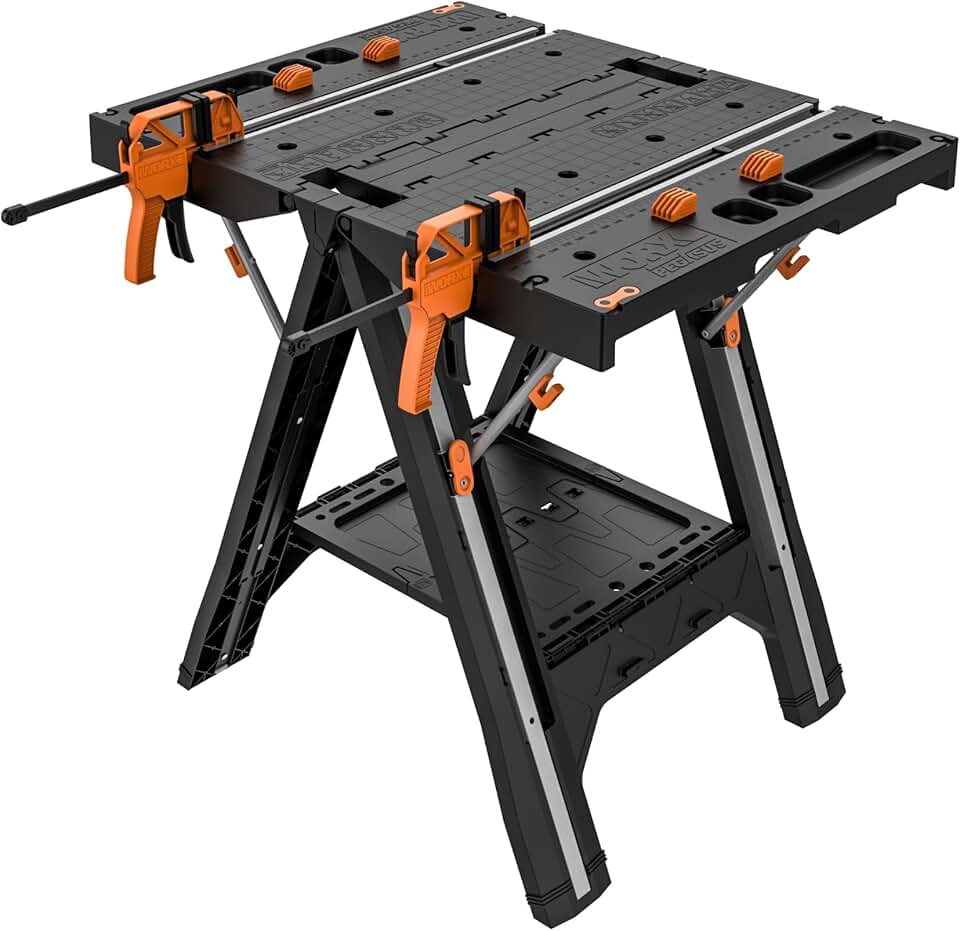
Pegasus Folding Work Table
- 2-in-1 design works as a workbench or sawhorse
- folds easily for quick storage and transport
- lightweight build makes setup simple anywhere
- includes clamps and clamp dogs for secure holding
- strong enough for a wide range of projects
Buy on Amazon

Portable Fold and Work Table
- Switches between sawhorse and workbench modes
- adjustable height supports different tasks
- folds down for easy carrying and storage
- includes clamps and bench dogs for better control
- ideal for DIY, repairs, and outdoor jobs
Buy on Amazon
Pro tip: use a portable bench with extra outfeed support for long boards. A light folding frame can tip when one end of a board hangs too far past the clamping surface, especially during sawing or routing.
Workbench FAQs
Workbench FAQs usually center on size, height, top material, thickness, and whether folding benches are worth buying. The short answers below give quick buying direction, while the earlier sections explain the trade-offs behind each choice.
Best Workbench Size
Best size: a 48-inch workbench works well for compact spaces, while a 60-inch or 72-inch workbench gives more room for tools, assembly, and repairs. A depth of 24 inches is practical against a wall, while 30 inches or more works better when the bench is accessible from multiple sides.
Best Workbench Height
Best height: most general-purpose workbenches are about 33–36 inches high. Lower benches suit heavy force, planing, and hammering, while taller benches around 38–42 inches suit precision work, electronics, carving, model building, and tasks where you don’t want to bend over.
Best Workbench Top Material
Best material: Hardwood is the best all-around workbench top material because it is durable, repairable, and clamp-friendly. MDF is flat and inexpensive, plywood is strong for DIY builds, steel is good for mechanical work, stainless steel cleans easily, and ESD laminate is best for electronics.
Workbench Top Thickness
Best thickness: a light-duty workbench top may be 3/4 inch thick, but a stronger general-purpose top is usually 1 to 1.5 inches thick. Woodworking benches often use 1.75-inch to 3-inch tops for better stiffness, clamping, and vise support.
Folding Workbench Value
Folding workbenches are worth it for small spaces, job sites, apartments, outdoor projects, and occasional DIY work. They store easily and move fast, but fixed garage workbenches and woodworking benches feel steadier under hammering, planing, clamping, vibration, and heavy vise pressure.
FAQs
What Is The Best Size For A Workbench?
The best size for a workbench depends on the space you have and the projects you do most often. For many hobbyists, a top around 60 to 72 inches long and 24 to 36 inches deep works well. If you build larger projects, a bigger bench gives you more room to work comfortably.
What Is The Best Height For A Workbench?
The best height for a workbench is usually around wrist height when you are standing upright. For most people, that means about 34 to 38 inches high. A lower bench is often better for heavy assembly, while a taller bench can feel more comfortable for detailed work.
What Is The Best Material For A Workbench Top?
The best material for a workbench top is solid hardwood, plywood, or butcher block, depending on your budget and use. Plywood is affordable and stable, while hardwood is more durable and repairable. If you need a tough, smooth surface, butcher block is a strong choice.
How Thick Should A Workbench Top Be?
A workbench top should usually be at least 1.5 to 2 inches thick for good strength and stability. Thicker tops handle heavy tools and clamping pressure better. If you use a layered plywood design, that can also create a very solid work surface without using one thick slab.
Are Folding Workbenches Worth It?
Folding workbenches are worth it if you need to save space or move your setup often. They are convenient for small garages, apartments, and mobile projects. For very heavy-duty work, a fixed bench is usually more stable and durable.


