


Spice racks organizers work best when they fit the cabinet opening, actual jar sizes, and the way you reach for seasonings. Measure first, compare access styles, and treat advertised jar capacity as a claim rather than a guaranteed fit.
Table of Contents
Measure for a Spice Rack Organizer
Measure the cabinet’s narrowest opening, clear interior depth, shelf height, and representative jars before buying a spice rack organizer. A rack can fit the interior yet remain impossible to insert through a narrow face frame.
Opening and Interior Width
Measure opening width at the top, middle, and bottom, then record the interior width behind the frame. Use the smallest usable width for pull-outs and rigid racks because older cabinets can be slightly out of square.
Check concealed hinges, shelf clips, door stops, and face-frame edges. These small obstructions often steal 1/4 inch or more exactly where a slide rail or expandable shelf needs space.
Usable Depth and Height
Measure depth from the front obstruction or closed-door plane to the rear wall, not from the decorative cabinet edge. Subtract space occupied by hinges, shelf lips, cables, pipes, brackets, and the door-closing path.
Vertical fit must include the organizer, tallest jar, and room to lift the jar. A bottle that fits with 1/8 inch above its cap can still scrape the upper shelf and feel awkward to remove.
Jar Sizes and Grip Space
Measure the shortest, tallest, and widest containers, including grinders and square seasoning bottles. Add finger clearance between slick glass jars; tightly packed jars may meet a capacity claim while remaining irritating to use.
A practical sample includes one short spice jar, one tall grinder, one wide rub container, and one square jar. Smooth jars make a sharp glass-on-glass click when packed too closely, a useful warning that the row needs more spacing.
Capacity and Fit Formulas
Use these formulas as planning estimates, then test with physical containers. Round capacity down rather than up because dividers, frame posts, uneven jars, and grip space reduce usable positions.
- Maximum organizer width = narrowest usable opening minus installation and movement clearance.
- Maximum organizer depth = clear interior depth minus hinge, door, and rear-wall clearance.
- Maximum organizer height = clear shelf height minus lift-out clearance.
- Estimated jars per row = usable shelf width ÷ average jar width.
- Estimated total capacity = jars per row × usable rows or tiers.
For example, a 14-inch usable row divided by 1.8-inch jars gives 7.77 positions. Round down to seven, then reduce that figure if one grinder or wide container joins the row.
Cardboard Collision Test
Cut cardboard to the organizer’s published width and depth, place representative jars on it, and test removal from the back. This collision test catches hinge contact, blocked shelf lips, and poor hand access before money or drill holes are involved.
For a door rack, tape a second template inside the door and add the deepest jar. Close the door slowly while watching the shelves; resistance, a dull tap, or hinge flex means the proposed position won’t work.
Compare Spice Organizer Types
The best organizer type depends on whether the main problem is hidden labels, poor reach, unused vertical space, or limited cabinet width. Visibility and access aren’t the same: risers reveal labels, while pull-outs and turntables bring rear jars forward.
Tiered and Expandable Shelves
A tiered spice rack suits shallow or medium-depth cabinets where front jars hide rear labels. Expandable versions fill wider shelves, but the overlapping joint may form a ridge that makes narrow jars wobble.
More tiers don’t automatically create more useful storage. A tall four-tier unit can consume lift-out room, and the rear row may still require a long reach over the jars in front.
Pull-Out Cabinet Racks
A pull-out spice rack is a better fit for deep or narrow cabinets because it moves rear jars into reach. Slide hardware consumes side space, so compare the complete installed width rather than the basket width alone.
Rails mounted slightly out of square can bind or make a dry scraping sound under load. Set both rails from the same front reference line, check diagonals, and test with full jars before tightening every screw.
Lazy Susans and Turntables
A lazy Susan spice organizer serves deep shelves and corners where rotation matters more than rectangular capacity. Round platforms leave unused corners, yet they prevent the repeated unloading needed to reach a jar at the back.
Check diameter, rim height, bearing movement, and overhead clearance. A level base should turn with steady fingertip pressure; jerky rotation can make tall grinders lean against a low retaining rim.
Anyone building a wood turntable can compare bearing size and load placement in this guide to lazy Susan hardware. Centering the bearing reduces the pulsing feel that appears when a loaded platform rotates off-axis.
Door and Wall Racks
Door and wall racks use vertical storage without occupying a shelf. Their limits are loaded weight, retaining-rail height, anchor quality, and clearance between jars and interior shelves.
Adhesive mounts can release from greasy, textured, or weak finishes. Clean compatible surfaces, respect the curing time stated by the maker, and avoid placing heavy glass jars over a breakable countertop.
Drawer Spice Organizers
A spice drawer organizer offers clear top-down labels and protects spices from direct light. Measure internal drawer height with the angled insert and largest jar in place, not the empty drawer depth.
Round jars roll and knock together without channels or liner. Full-extension slides also matter because the rear section of a short-opening drawer can remain hidden beneath the counter.
Countertop Spice Racks
A countertop spice rack keeps daily seasonings close but uses preparation space and collects airborne grease. Place it away from direct sun, the kettle, dishwasher vent, and the humid plume above a stove.
Test stability by removing a jar one-handed from the highest position. A light rack that rocks, skates, or rings against the counter needs rubber feet, a heavier base, or a less exposed location.
Tiered and Expandable Spice Rack Picks
These tiered organizer picks cover compact, wide, bamboo, four-tier, and expandable metal layouts. Verify seller dimensions and included parts against your cardboard template before ordering.
Compare the five cabinet and pantry risers below.

Easy View 3 Tier Rack
- Three raised tiers improve visibility
- Compact 10 inch cabinet-friendly design
- Holds spices oils and condiments
- Creates orderly pantry or countertop storage
- Makes frequently used items easy to reach
 Buy on Amazon

Wide 3 Tier Pantry Riser
- Wide 15 inch design adds useful storage
- Three tiers keep items visible
- Non-skid surface helps jars stay put
- Organizes spices cans and seasonings
- Clean white and gray styling suits most kitchens
Buy on Amazon

Bamboo Expandable Spice Riser
- Natural bamboo brings warmth to storage
- Expandable width fits changing spaces
- Three tiers improve spice visibility
- Great for cabinets cupboards and pantries
- Keeps small jars neatly arranged
Buy on Amazon

Adjustable 4 Tier Spice Shelf
- Four tiers provide high-capacity storage
- Adjustable shelf layout fits assorted jars
- Raised levels make labels easier to read
- Works on kitchen counters or inside cabinets
- Bright black finish adds a sleek touch
Buy on Amazon

Expandable Metal Spice Rack
- Expands from 13 inch to 21.5 inch
- Three tiers organize jars and bottles
- Metal construction offers sturdy everyday support
- Slip-resistant design helps keep items stable
- Fits countertops cabinets and pantry shelves
Buy on Amazon
Easy View 3 Tier
The Easy View model uses a compact 10-inch width and three raised rows, making it a practical spice rack organizer for a small cabinet. It improves label sightlines but doesn’t bring the back row closer.
Wide 3 Tier Riser
The Wide 3 Tier Pantry Riser spans a stated 15 inches and includes a non-skid surface. It suits a wide shelf containing spices, cans, or condiments, provided the cabinet opening also clears that width.
Bamboo Expandable Riser
The Bamboo Expandable Spice Riser adds a warm wood tone and adapts to changing shelf width. Wipe turmeric or oily sauce quickly—the yellow-orange pigment can stain, while prolonged moisture may raise grain or distort unfinished bamboo components.
Adjustable 4 Tier Shelf
The Adjustable 4 Tier Spice Shelf provides more label levels than a three-tier riser. Check combined rack and jar height carefully because the fourth tier can place grinders close to the shelf above.
Expandable Metal Rack
The Expandable Metal Spice Rack has a stated range of 13 to 21.5 inches. Test it near maximum extension with full glass jars, since the center overlap may flex or offer less flat storage than the headline width suggests.
Pull-Out and Rotating Organizer Picks
Choose pull-out storage for reach in a narrow or deep cabinet; choose a turntable for corner access and mixed containers. Both styles need movement clearance, which fixed risers don’t require.
Compare the sliding and expandable cabinet options below.

Slide Out Spice Storage
- Three pull-out racks maximize cabinet access
- Two tiers hold up to 10 jars each
- Sliding design prevents digging through shelves
- Designed for narrow cabinet spaces
- Black finish delivers a clean modern look
Buy on Amazon

Spicy Shelf Expandable Rack
- Expandable design adapts to cabinet width
- Two tiers make spices easier to see
- Helps turn crowded shelves into organized storage
- Suitable for cabinets and pantry spaces
- Keeps seasonings within easy reach
Buy on Amazon
Slide Out Spice Storage
Supplied listing data describes three pull-out racks and two-tier sections holding up to 10 jars each. Confirm the exact configuration, installed width, extension distance, mounting method, and loaded stability with your own jars rather than multiplying the claim blindly.
During setup, load the heaviest glass jars first and pull the rack fully forward. A cabinet that tips, a rail that drags, or screws that shift under this test signals a mounting or weight problem.
Spicy Shelf Expandable Rack
The Spicy Shelf Expandable Rack uses two levels and width adjustment without slide hardware. It works for visibility across a broad shelf, though mixed containers can expose unstable areas around the center overlap.
Clear 2 Tier Lazy Susan
The Clear 2 Tier Lazy Susan rotates jars to the front and doubles vertical storage where cabinet height permits. Check the complete diameter and test tall bottles on both tiers before choosing this rotating organizer.
The boxed product view provides the supplied features and purchase details.
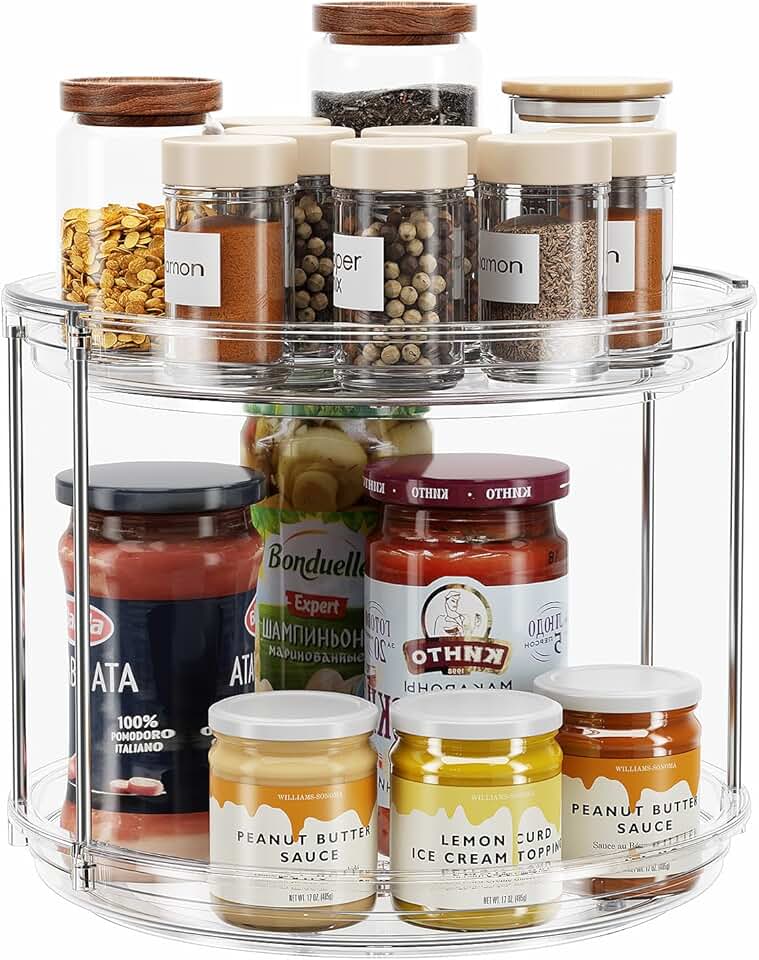
Clear 2 Tier Lazy Susan
- Rotating design brings items within reach
- Two tiers double vertical storage
- Clear sides make contents easy to spot
- Useful in kitchens bathrooms and vanities
- Recycled standard material supports mindful organization
Buy on Amazon
A low rim may let top-heavy grinders lean outward during a quick spin. Clear sides make residue easy to see, but fingerprints, paprika dust, and oil streaks also show faster than on opaque materials.
Coordinated Spice Jar Systems
Coordinated systems suit cooks who want predictable spacing, matching labels, and a unified cabinet or countertop. The main trade-offs are transfer time, glass weight, duplicate leftovers, and loss of package information.
Compare the two 28-jar systems below.

Complete Spice Rack Set
- Includes 28 matching spice jars
- Comes with hundreds of preprinted labels
- Funnel and chalk marker simplify filling
- Fits cabinets countertops and pantry shelves
- Wall or door mounting adds flexibility
Buy on Amazon

28 Jar Spice Organizer Set
- Includes 28 empty jars with black lids
- Funnel makes refilling neat and simple
- Labels help identify seasonings quickly
- Organizes cabinets counters and pantry shelves
- Creates a coordinated spice storage setup
Buy on Amazon
Complete Spice Rack Set
The Complete Spice Rack Set includes 28 matching jars, hundreds of preprinted labels, a funnel, and a chalk marker according to the supplied listing data. Its cabinet, counter, pantry, wall, or door placement remains subject to space and loaded-weight checks.
28 Jar Organizer Set
The 28 Jar Spice Organizer Set includes 28 empty jars with black lids, labels, and a filling funnel. It makes spacing more predictable, but the complete arrangement still needs enough shelf area for all jars.
Decanting Trade-Offs
Decanting takes time and may leave half a pouch without a home when the new jar fills. Glass also adds weight, while discarding the original package can remove allergen statements, ingredient lists, lot codes, and preparation directions.
Photograph both package panels before disposal and keep any allergen-critical label with the refill supply. Wash and dry jars fully before filling; trapped moisture can cause powder to cake into hard, dark clumps.
Labels and Refill Dates
Label fronts for risers and door racks, lids for drawers, and both surfaces when jars move between locations. Record the refill date in plain, high-contrast text rather than relying on decorative labels that blur at arm’s length.
Use a removable date sticker or write on the jar’s base with an appropriate marker. Don’t pour a fresh refill over old spice before checking aroma, color, and signs of moisture.
Compare Fit, Materials, and Cost
Compare a spice organizer by verified fit, usable jar positions, material, installation, and complete system expense. The cheapest rack can cost more per useful position if mixed jars leave half its advertised spaces unusable.
Spice Rack Comparison Table
This spice racks organizers comparison separates supplied claims from measurements that must be confirmed at home. “Not provided” avoids inventing dimensions absent from the supplied product data.
| Product or type | Best use | Width | Depth | Height | Adjustment | Tiers | Claimed capacity | Verified or estimated capacity | Material | Installation | Renter-friendly | Non-slip | Mixed jars | Main advantage | Main limitation | Price check |
|---|---|---|---|---|---|---|---|---|---|---|---|---|---|---|---|---|
| Easy View 3 Tier | Small cabinet | 10 in stated | Not provided | Not provided | Fixed | 3 | Not provided | Measure jars | Not provided | No | Yes | Not provided | Yes, with spacing loss | Compact visibility | Rear reach unchanged | Check listing before purchase |
| Wide 3 Tier Riser | Wide pantry shelf | 15 in stated | Not provided | Not provided | Fixed | 3 | Not provided | Measure jars | Not provided | No | Yes | Yes | Yes | Wide label view | Needs a wide opening | Check listing before purchase |
| Bamboo Expandable Riser | Visible wood cabinetry | Expandable; range not provided | Not provided | Not provided | Width | 3 | Not provided | Measure jars | Bamboo | No | Yes | Not provided | Yes | Warm appearance | Moisture and stain care | Check listing before purchase |
| Adjustable 4 Tier Shelf | Maximum label levels | Not provided | Not provided | Not provided | Shelf layout | 4 | Not provided | Measure jars | Not provided | No | Yes | Not provided | Yes | Four sightlines | High vertical demand | Check listing before purchase |
| Expandable Metal Rack | Wide adjustable shelf | 13–21.5 in stated | Not provided | Not provided | Width | 3 | Not provided | Measure at chosen width | Metal | No | Yes | Slip-resistant design stated | Yes | Broad width range | Overlap may reduce flat area | Check listing before purchase |
| Slide Out Spice Storage | Deep or narrow cabinet | Not provided | Not provided | Not provided | Sliding access | 2-tier sections stated | Up to 10 jars per section stated | Test with actual jars | Not provided | Check mounting method | Depends on mounting | Not provided | Capacity drops with wide jars | Brings rear jars forward | Rail and top clearance | Check listing before purchase |
| Spicy Shelf Expandable Rack | Crowded wide cabinet | Expandable; range not provided | Not provided | Not provided | Width | 2 | Not provided | Measure jars | Not provided | No | Yes | Not provided | Yes | No slide installation | Center overlap | Check listing before purchase |
| Clear 2 Tier Lazy Susan | Deep shelf or corner | Diameter not provided | Diameter not provided | Not provided | Rotating | 2 | Not provided | Test full rotation | Clear recycled material stated | No | Yes | Raised sides stated | Yes, with balance limits | Rotates items forward | Wastes square corners | Check listing before purchase |
Measure before buying: product specifications, sellers, and bundle contents can change. Recheck every dimension shown on the purchase page and compare it with the cabinet template.
Verified Capacity and Jar Fit
Verified capacity means the number of your jars that fit while remaining readable and removable. Test short jars, square jars, grinders, and wide rub containers instead of using a row of identical samples.
A rack holding 20 matching jars may hold only 13 mixed containers after grip gaps are added. Treat lost positions as a normal fit cost, not a measurement failure.
Total Installed Cost
Total installed cost includes the rack, jars, labels, funnel, liner, mounting hardware, wall anchors, replacement adhesive, delivery, and any cabinet repair. Rack-and-jar bundles can offset separate accessory purchases, but only if most included jars will be used.
Cost per Usable Position
Calculate cost per usable position by dividing complete installed cost by the number of jars that pass your fit test. A $45 system holding 18 usable jars costs $2.50 per position; one holding only 12 mixed jars costs $3.75.
Materials and Durability
Metal frames offer rigidity, but chipped coatings can expose steel to humid air and wire shelves may need a liner for small jars. Thin plastic feels light and wipes clean, yet it can bow under a dense row of glass.
Clear plastic shows labels and residue equally well. Bamboo feels warm and dry under the hand, but water left around an expansion seam can darken the grain or create a rough raised edge.
Installation and Failure Risks
Practical notes from use: the most common failures are binding slides, door collisions, weak anchors, peeling adhesive, tipping turntables, and shelves that flex under full glass jars. Test the organizer at realistic load before filling every position.
Pull-out rails need parallel reference lines and solid screw purchase. For removable hardware in suitable wood panels, correctly sized threaded inserts can create repeatable fastening, but cabinet-panel thickness must safely accommodate them.
Before drilling into a wall, locate framing, pipes, and wiring, then match the fastener to the wall material and expected loaded weight. Cabinet doors need the same caution because thin center panels may hold less than solid stiles.
Choose by Kitchen Problem
Choose a spice storage organizer by the problem it fixes: a compact riser for hidden labels, a pull-out for poor rear access, a turntable for corners, or matching jars for predictable spacing. The right format reduces the number of containers moved during one retrieval.
Small or Wide Cabinets
For a small cabinet, the stated 10-inch Easy View rack offers compact three-tier visibility without installation. Wide shelves can use the 15-inch riser or 13-to-21.5-inch expandable metal rack, subject to opening clearance.
Deep or Narrow Cabinets
Deep cabinets benefit from sliding or rotating access because raised labels alone don’t shorten the reach. In a narrow opening, include slide rails, mounting heads, and door-hinge intrusion in the installed width.
Corners and Pantry Shelves
Use a turntable where reaching around a corner is the main frustration. Use a wide or expandable riser on a straight pantry shelf where rectangular surface use and front-facing labels matter more than rotation.
Renters and Small Kitchens
Renters can use freestanding risers, turntables, expandable shelves, and removable drawer inserts. Adhesive racks appear temporary, but they can lift paint, veneer, or cabinet finish during removal, so test a hidden area and review lease terms.
In a small kitchen, avoid trading all usable counter space for decorative storage. A shallow drawer insert or narrow cabinet riser often protects the work surface while keeping daily spices close.
Maximum Visibility
For maximum visibility, combine a three- or four-tier rack with high-contrast front labels and jars of similar height. Check that the highest tier still leaves enough room to grip and lift every container.
Coordinated Appearance
Matching jars and aligned labels create predictable rows and a calm visual pattern. Buy a 28-jar system only if the storage location fits the complete set and most positions will hold seasonings you use.
Organize and Protect Spices
Store spices in a cool, dry, dark location and arrange them so older containers stay visible. A good organizer improves access, but it can’t protect aroma from repeated heat, sunlight, steam, or loose lids.
Group by Cooking Use
Group jars by everyday cooking, baking, grilling, whole spices, herbs, blends, and salts. Put the most-used group on the easiest tier or pull-out section rather than arranging everything alphabetically across several locations.
- Remove expired, empty, or duplicate containers.
- Group seasonings by cooking task.
- Place daily jars at the front or on the lowest visible tier.
- Keep occasional baking and grilling spices together.
- Reserve oversized refills for a separate pantry zone.
Label Fronts and Lids
Front labels suit cabinet racks, while lid labels suit drawers and low bins. Use both when jars move, and choose large letters with strong contrast so cumin and cinnamon aren’t confused during fast cooking.
Rotate Older Spices Forward
Move older spices to the front before adding a refill and check their aroma first. Crushing a small pinch between warm fingers should release a distinct scent; a dusty, faint smell signals reduced quality.
Keep a short inventory on a cabinet note or phone list. This simple habit prevents buying a third jar hidden behind two nearly full duplicates.
Limit Heat, Light, Moisture
Keep jars tightly closed and away from direct sunlight, range heat, dishwasher vents, and persistent humidity. Don’t shake the main jar over a steaming pan; spoon out what you need with a clean, dry utensil.
Steam entering a cool jar can leave fine powder clinging to the glass and later form hard lumps. Wipe oily lids and jar bases before returning them so the organizer doesn’t develop a sticky film.
Spice Quality-Life Ranges
Spice dates usually describe quality rather than safety when containers remain dry and intact. McCormick’s spice shelf-life guidance cites broad ranges of about two to four years for ground spices, three to four years for whole spices, and one to three years for leafy herbs.
Heat, light, air exposure, package integrity, and refill habits can shorten those ranges. Check scent and color before discarding by date alone, but throw away any spice showing moisture, mold, insects, damaged packaging, or an unusual odor.
FAQs
What Is The Most Efficient Way To Organize Spices In A Cabinet?
The most efficient way to organize cabinet spices is to group them by use and keep labels facing forward. Place everyday seasonings at eye level, then arrange baking spices, blends, and less-used jars in separate sections. A tiered shelf or drawer-style organizer makes every jar easier to see and reach.
Is A Pull-Out Spice Rack Better Than A Tiered Rack?
A pull-out spice rack is better for deep cabinets because it brings every jar into view. Tiered racks are usually more affordable and work well in shallow cabinets with easy front access. Choose a pull-out model for maximum visibility, or use tiers when you need a simple space-saving solution.
How Do I Measure A Cabinet For A Spice Rack Organizer?
Measure the cabinet’s inside width, depth, and height before choosing a spice rack organizer. Account for door hinges, shelf lips, and any center supports that may reduce usable space. For pull-out racks, also check the manufacturer’s required clearance and leave enough room for the unit to slide smoothly.
How Many Jars Can A Spice Rack Actually Hold?
A spice rack can typically hold between 12 and 60 jars, depending on its size and design. Small countertop racks often fit 12 to 20 jars, while cabinet pull-outs and door-mounted systems can store much more. Check the shelf dimensions because oversized spice bottles take up extra space.
Can A Spice Rack Be Mounted Inside A Cabinet Door?
Yes, many spice racks can be mounted inside a cabinet door if there is enough clearance for the shelves and jars. Measure the door’s interior panel and close the door slowly to confirm jars will not hit cabinet shelves. Use appropriate screws and avoid mounting on thin or damaged doors.


